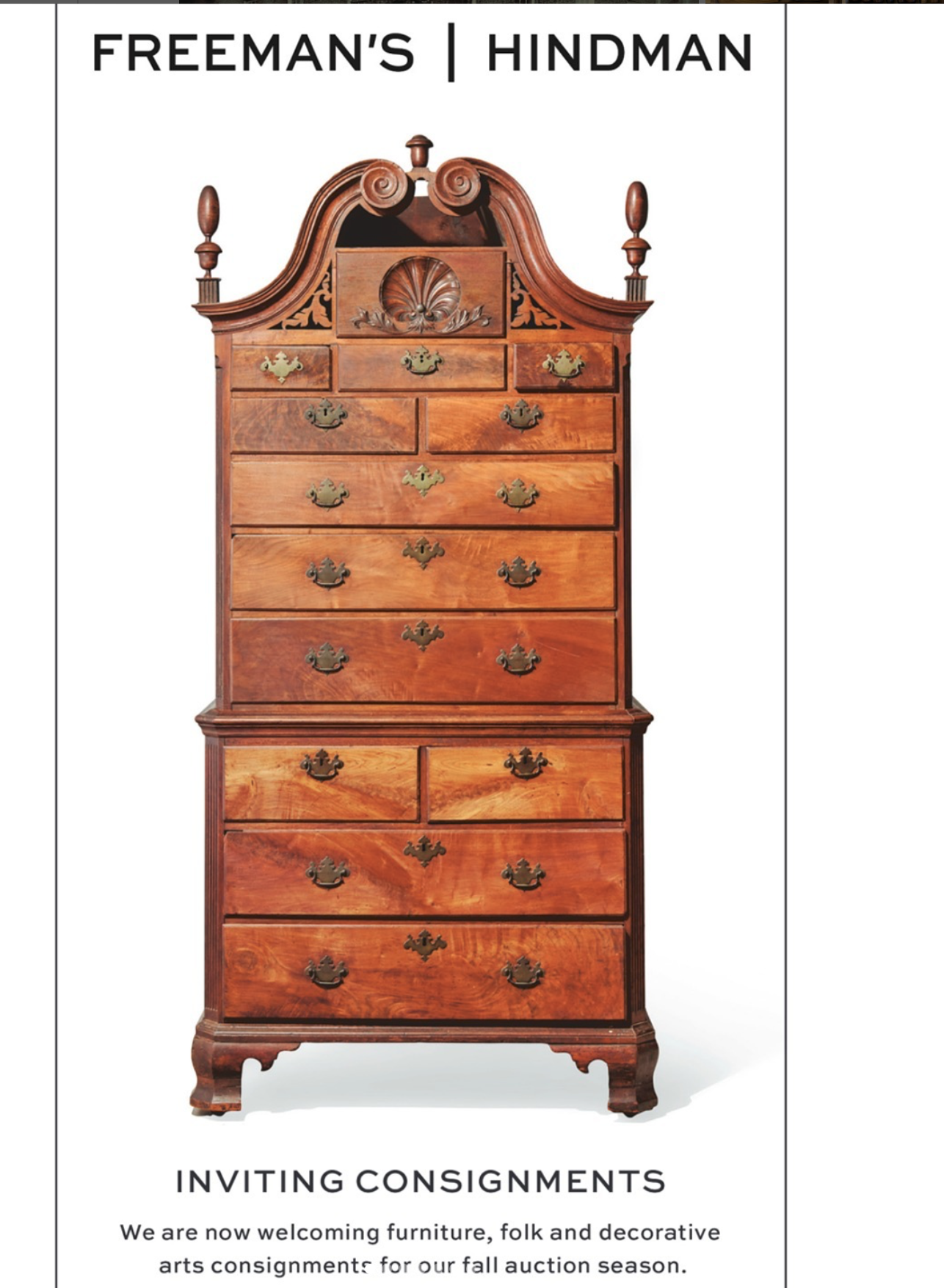
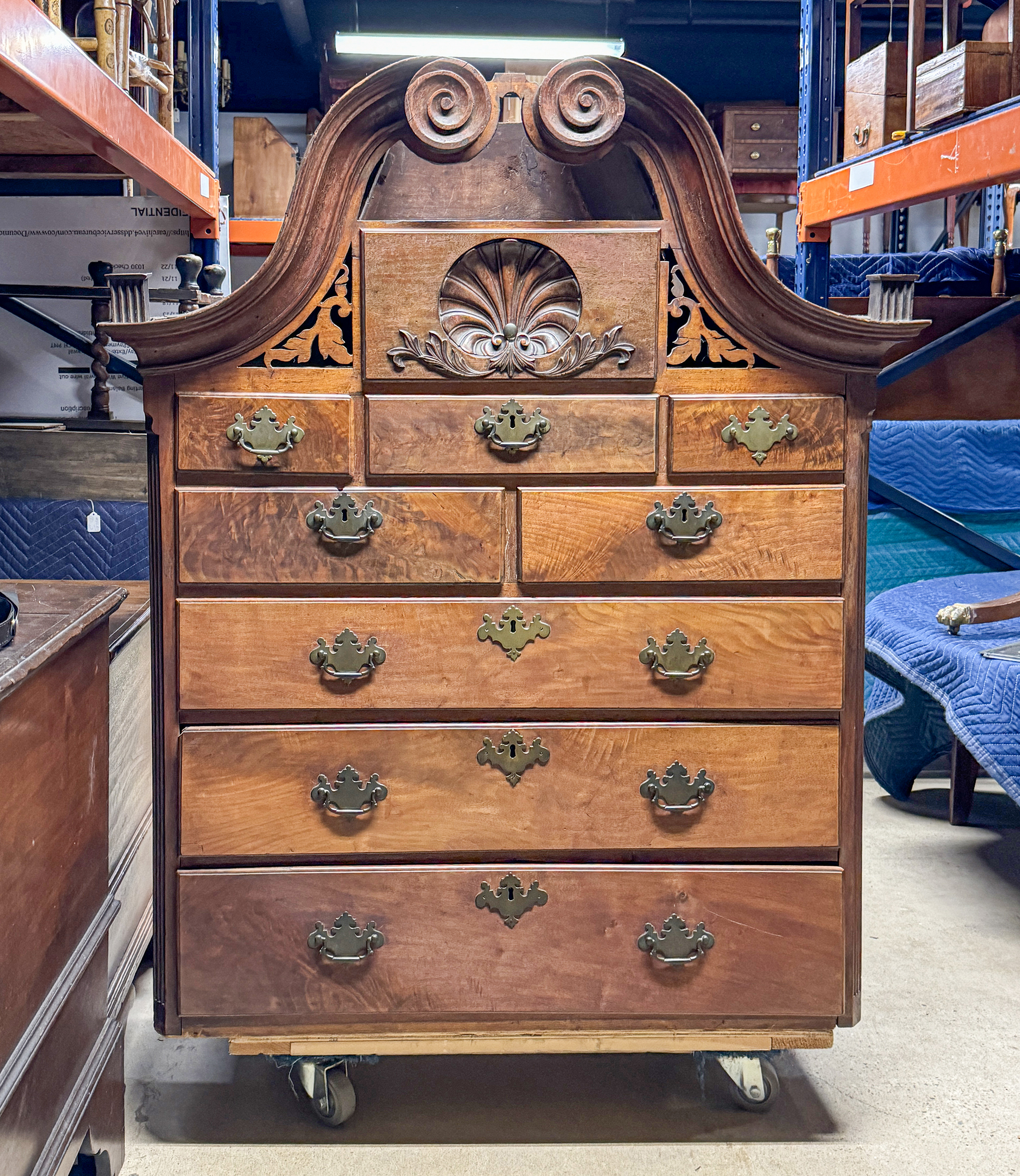
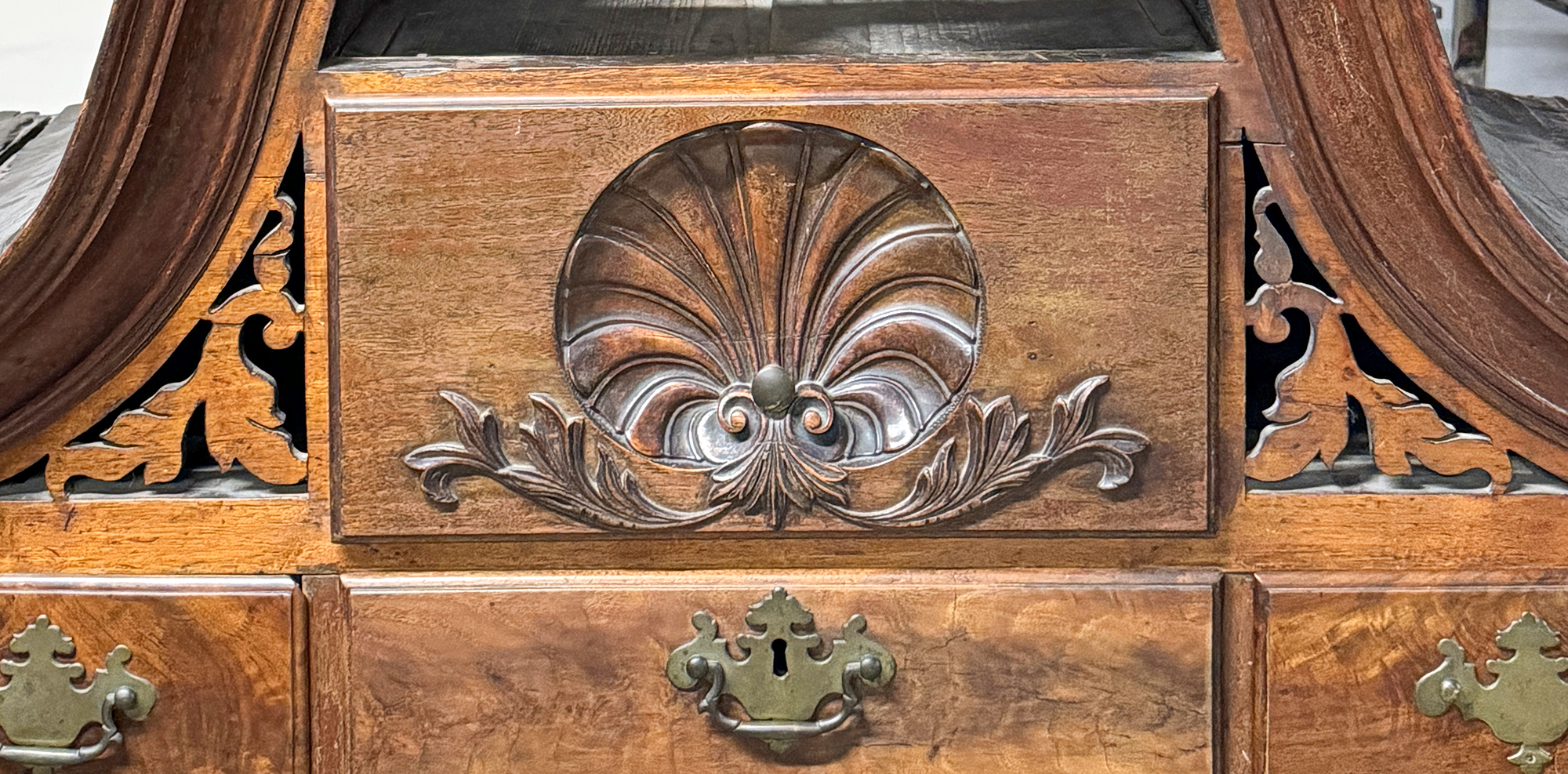
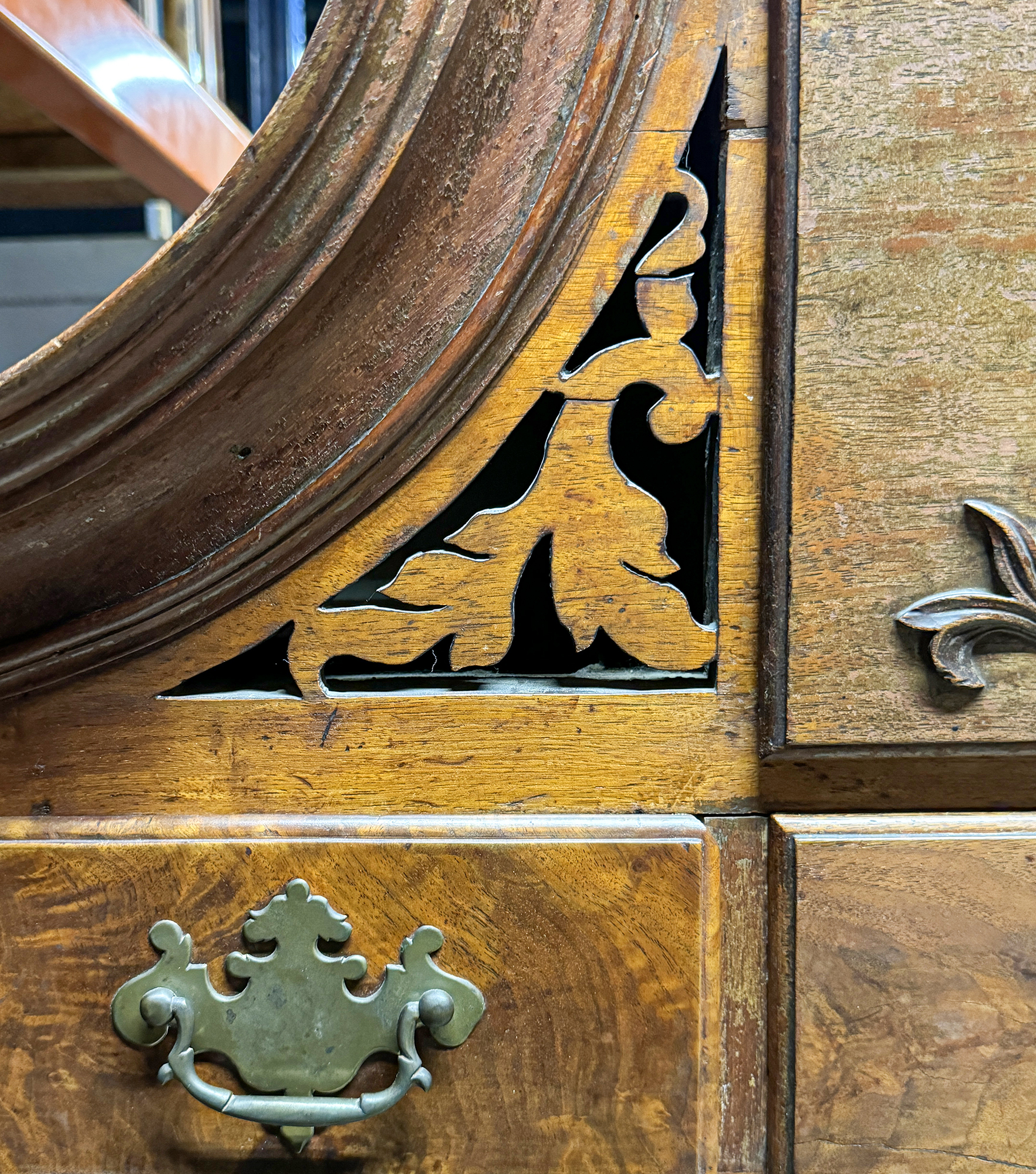
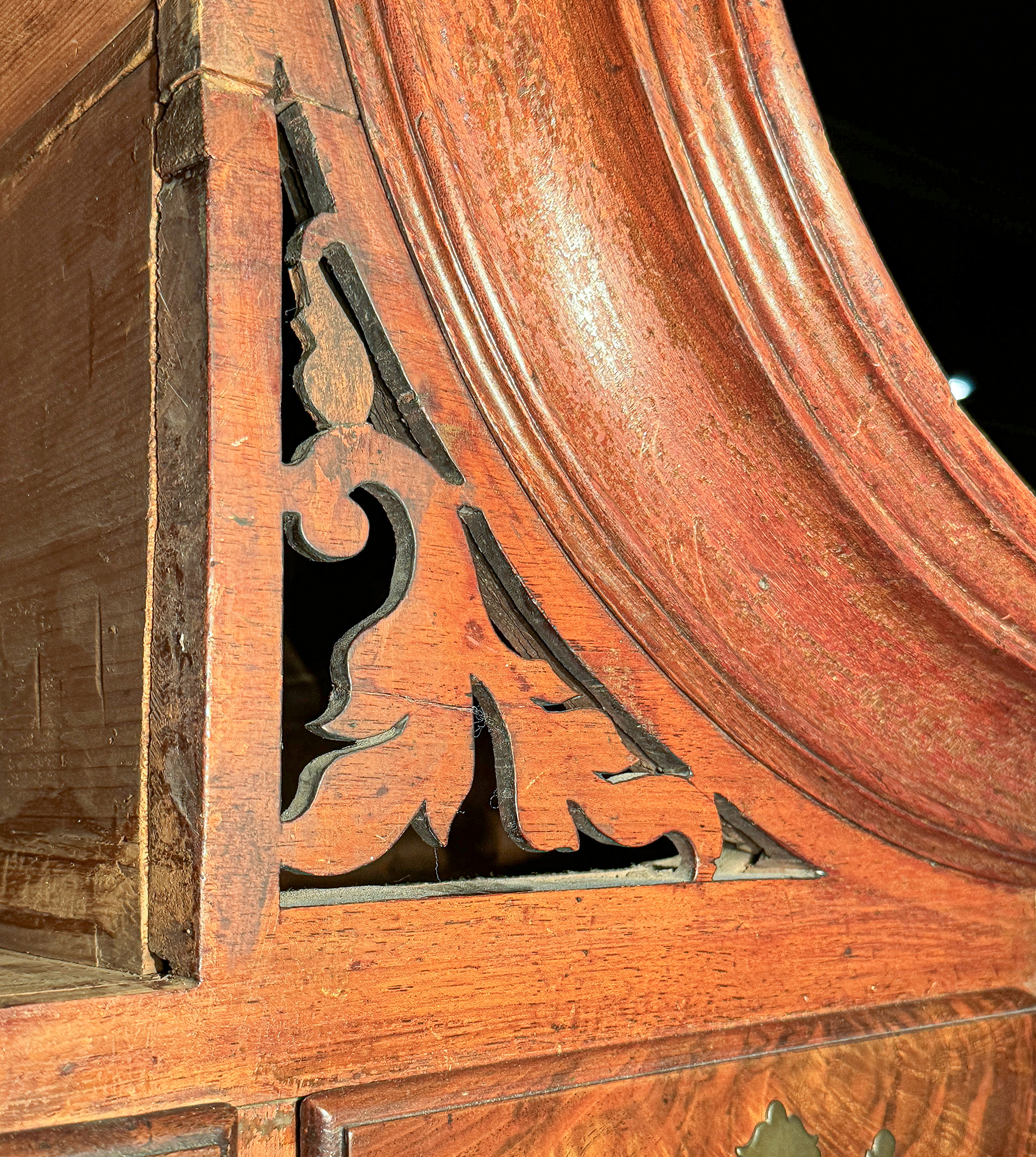
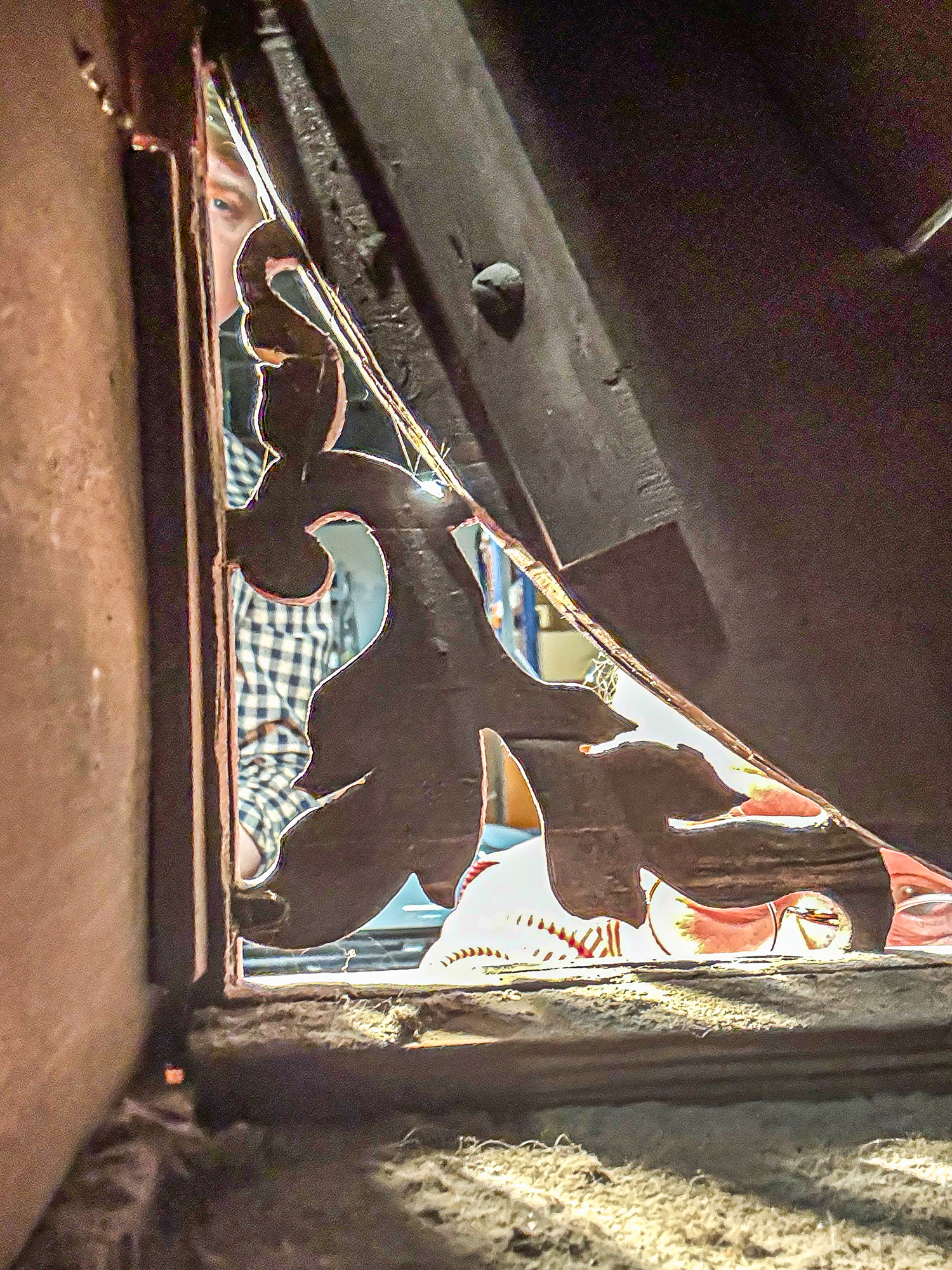
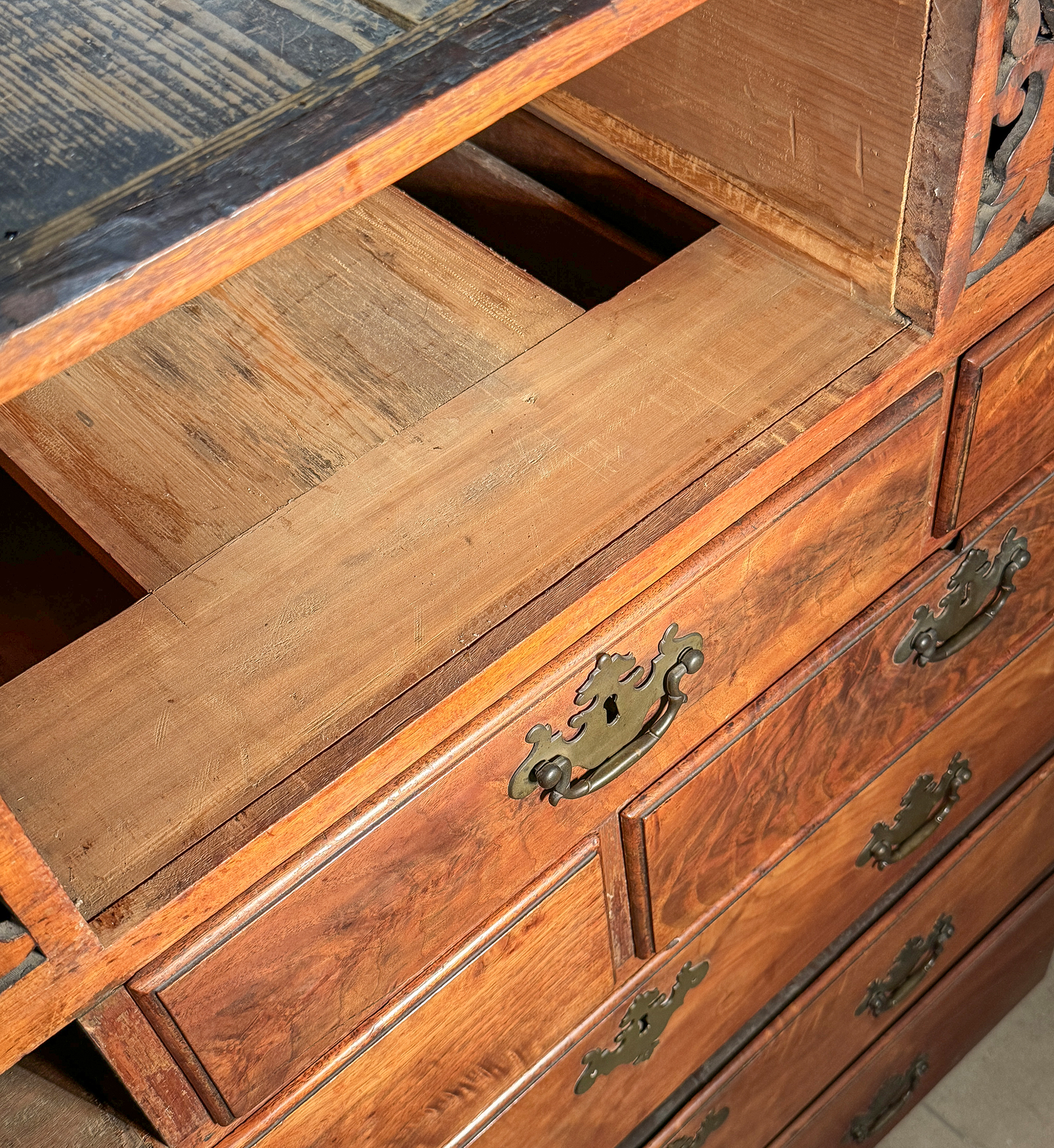
A chest on chest, or double chest of drawers, made in Philadelphia c.1750 will be at auction at Freeman’s | Hindman, November 19, 2024. It presents a notable and perhaps unique decorative device – the tympanum board on either side and above the carved shell drawer is reduced in thickness from behind. A pierced design referencing the applied carving on the shell drawer was then sawn in these spaces. The pierced work above the drawer is missing but evidence of the reduced thickness is easily seen.
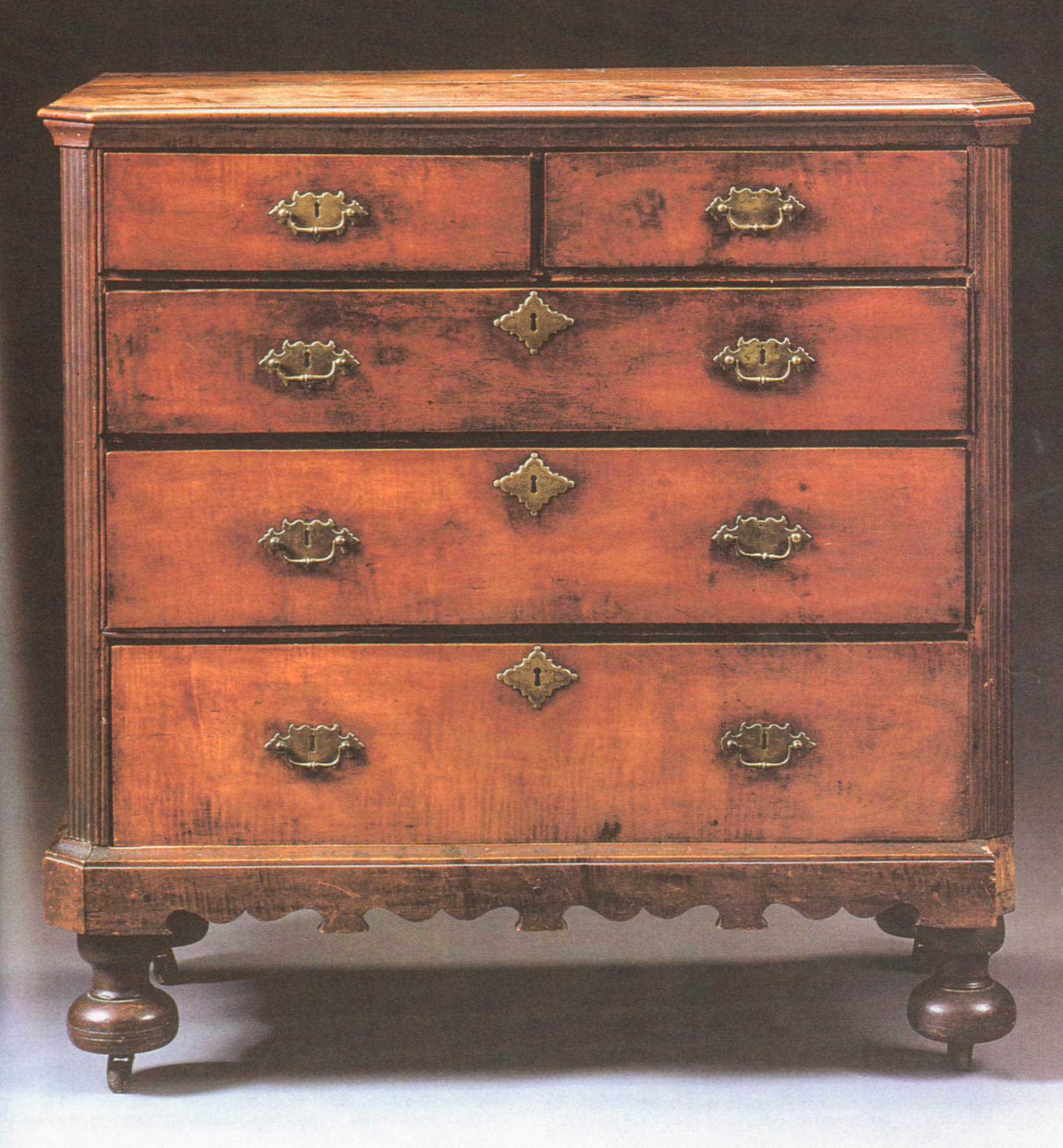
Philadelphia joiners were constructing the chest on chest form by the late 1720s. While John Head did not designate any furniture he made as a “chest on chest” two chest on chests and the lower fragment of a chest on chest have been attributed to him. All three were likely made in the 1730s or early 1740s. They have square heads (flat tops), four tiers of drawers in each case, half inch rails with applied double arch moulding, turned feet, and a base moulding with a decoratively sawn lower edge. The corners of the chest that survives without its upper chest has chamfered and fluted corners like those on the Freeman’s | Hindman chest.
Lower case of a chest on chest attributed to John Head. Made in Philadelphia, c. 1735. Maple, hard pine, Atlantic white cedar. The upper case is missing. A top board has been added converting it into a low chest.
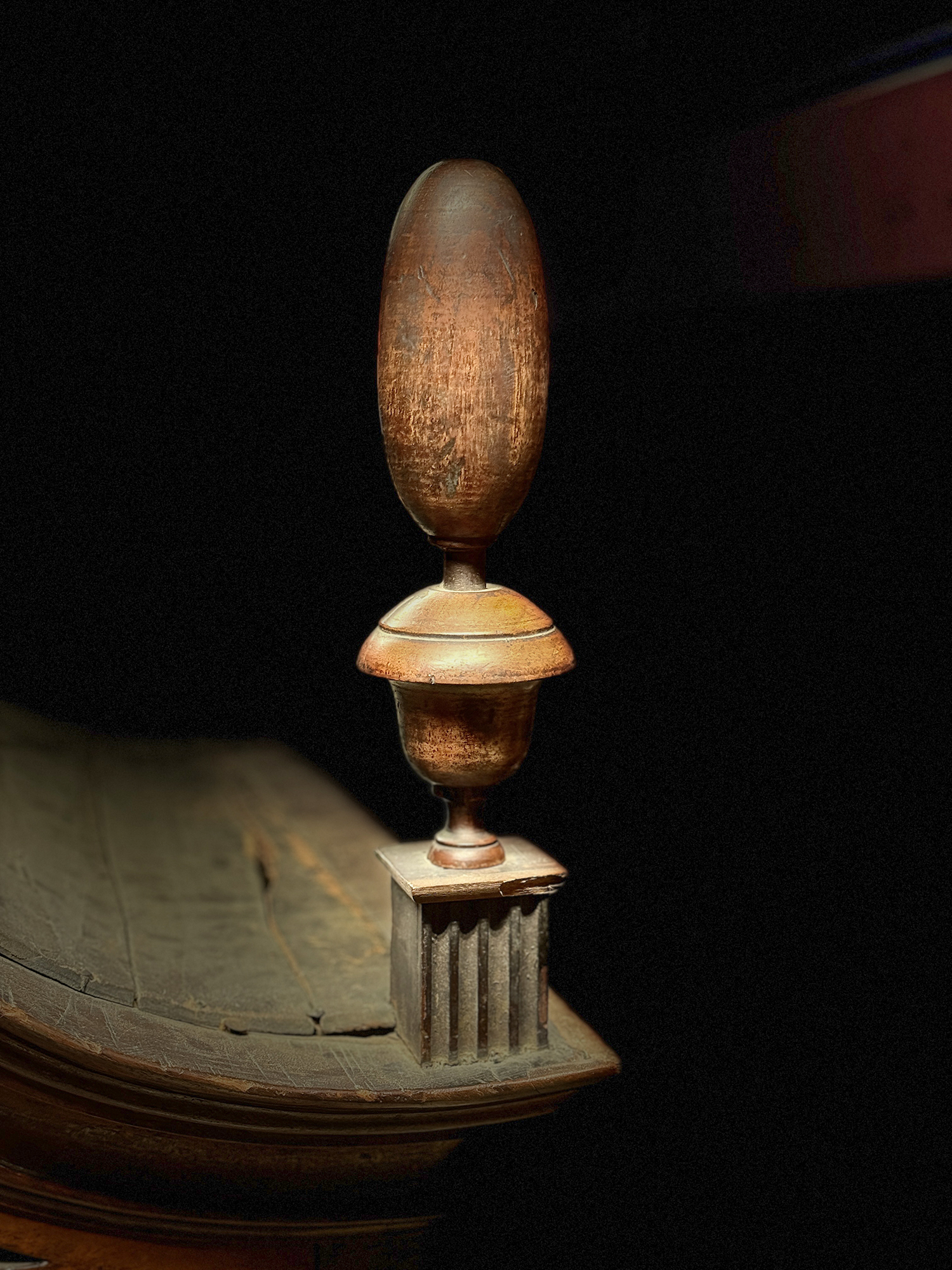
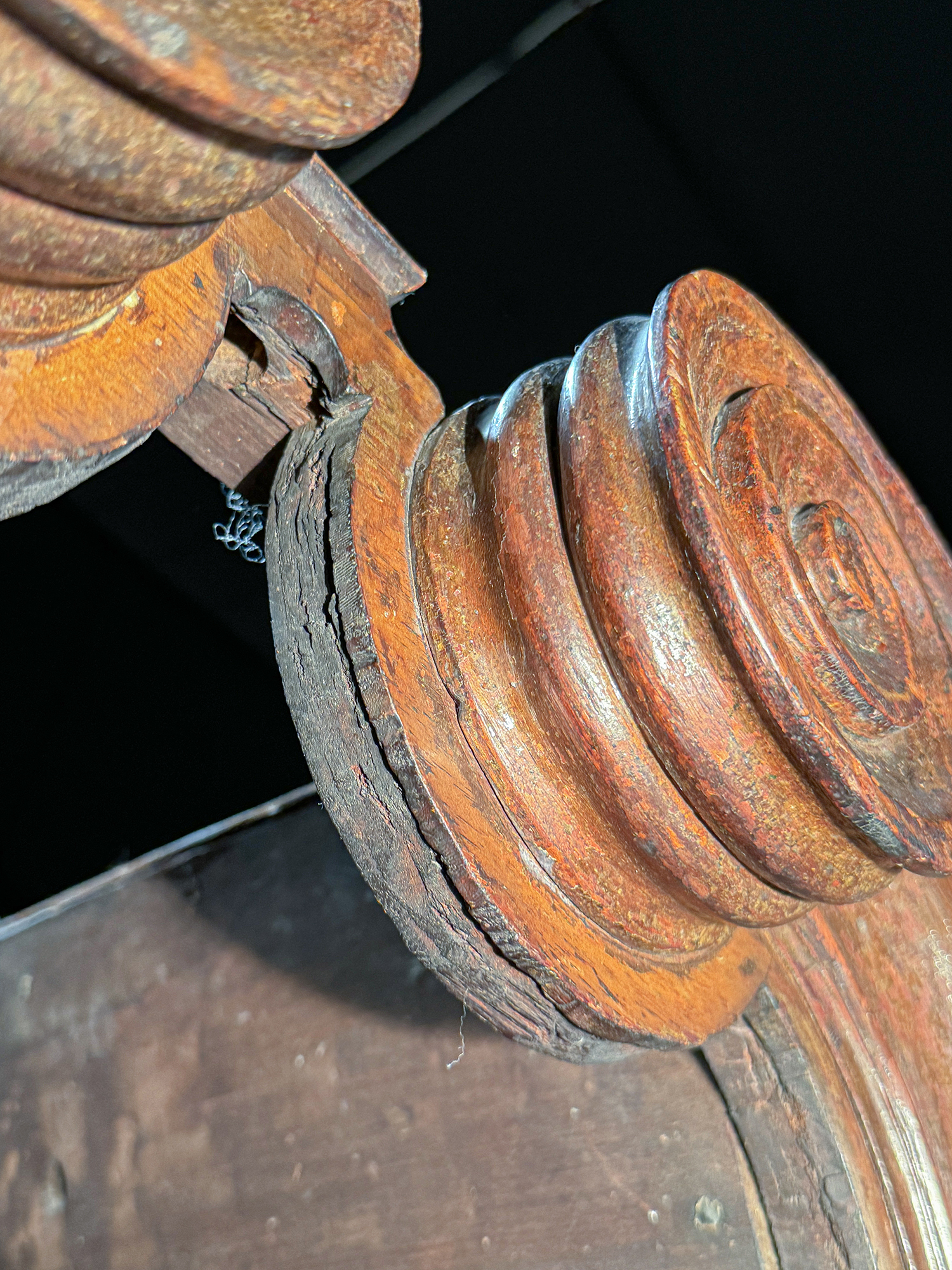
A number of related chest on chests and high chests are illustrated in an article on the Claypoole family of joiners and an article on a trio of mid-eighteenth century Philadelphia carvers in American Furniture 2002 and 2020 respectively. The majority of the ogee tops of the chests on chests in the articles terminate with a return moulding. The remaining ogee tops end in a scrolls with separate carved “roses” attached with glue and nails. The Freeman | Hindman chest on chest ogee cornice moulding, however, ends in a carved quasi-architectural Ionic capital scroll.
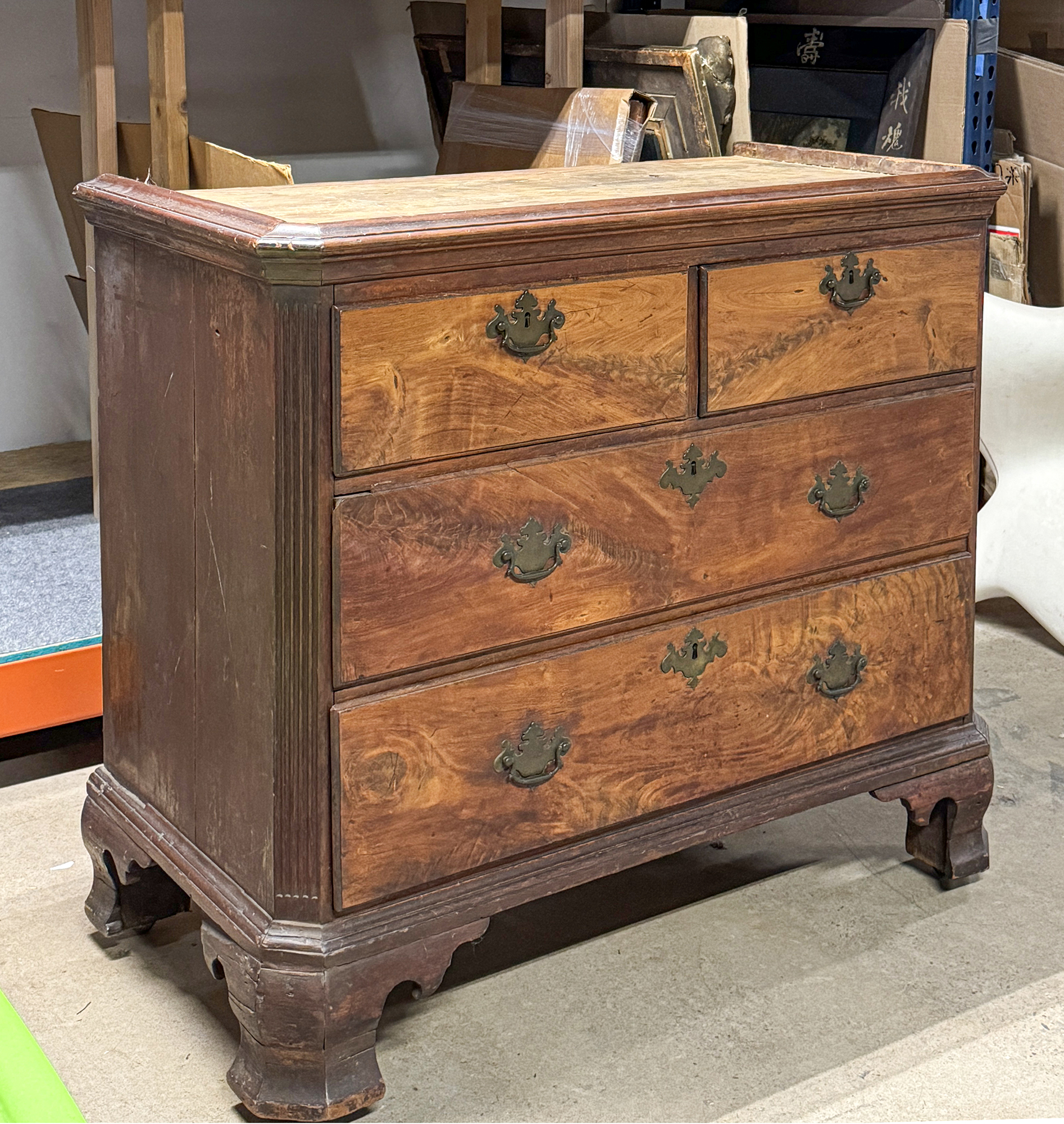
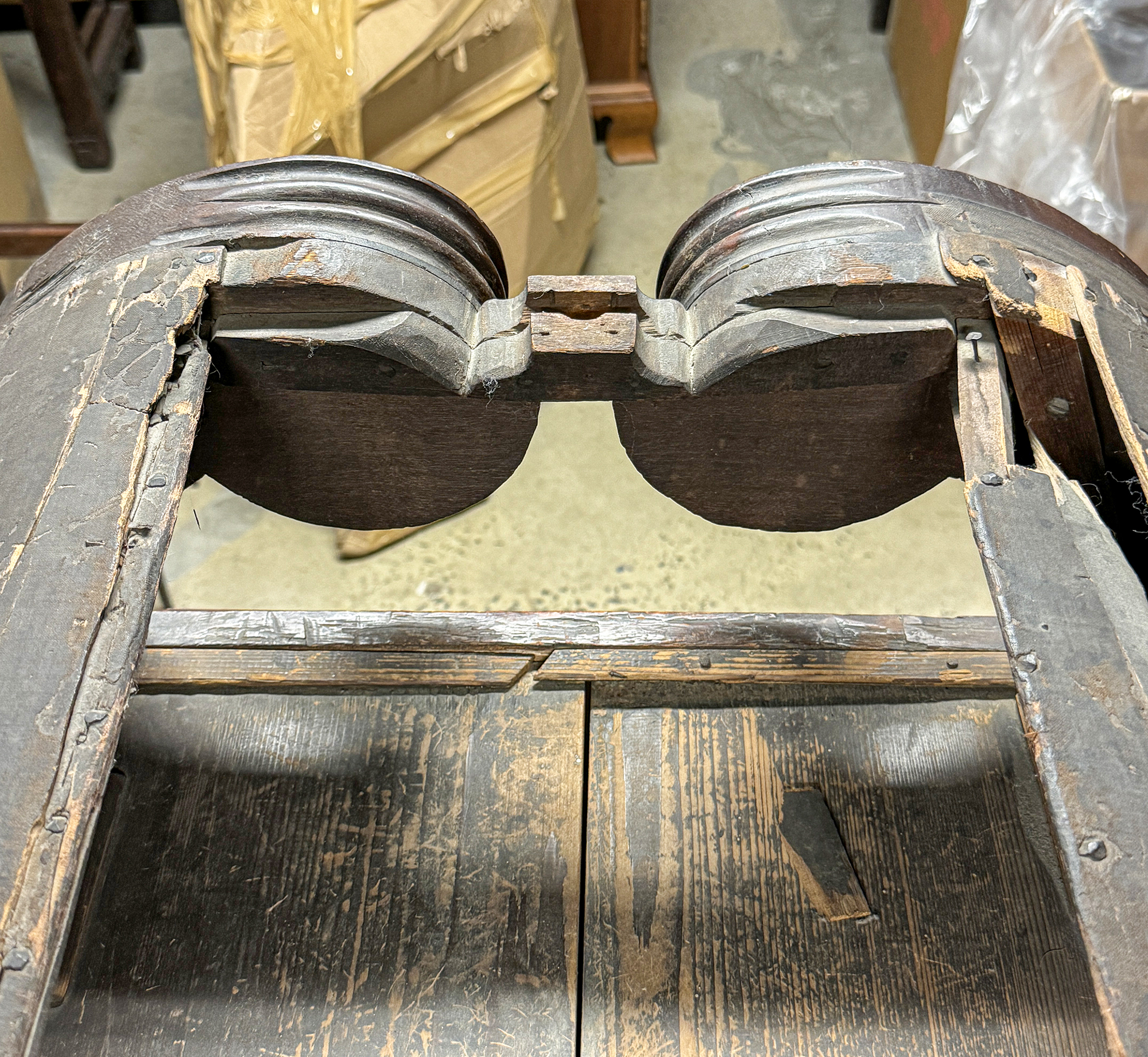
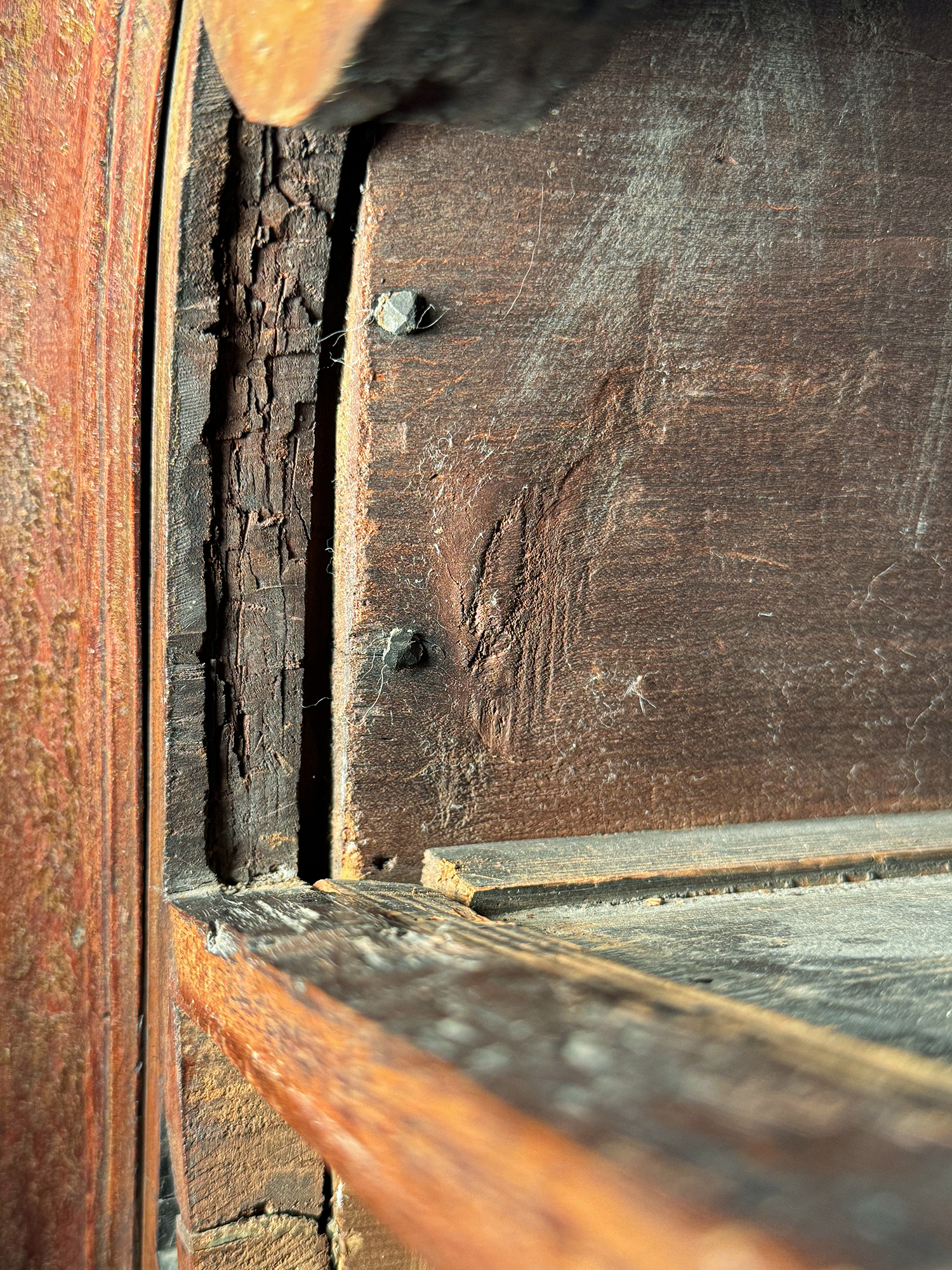
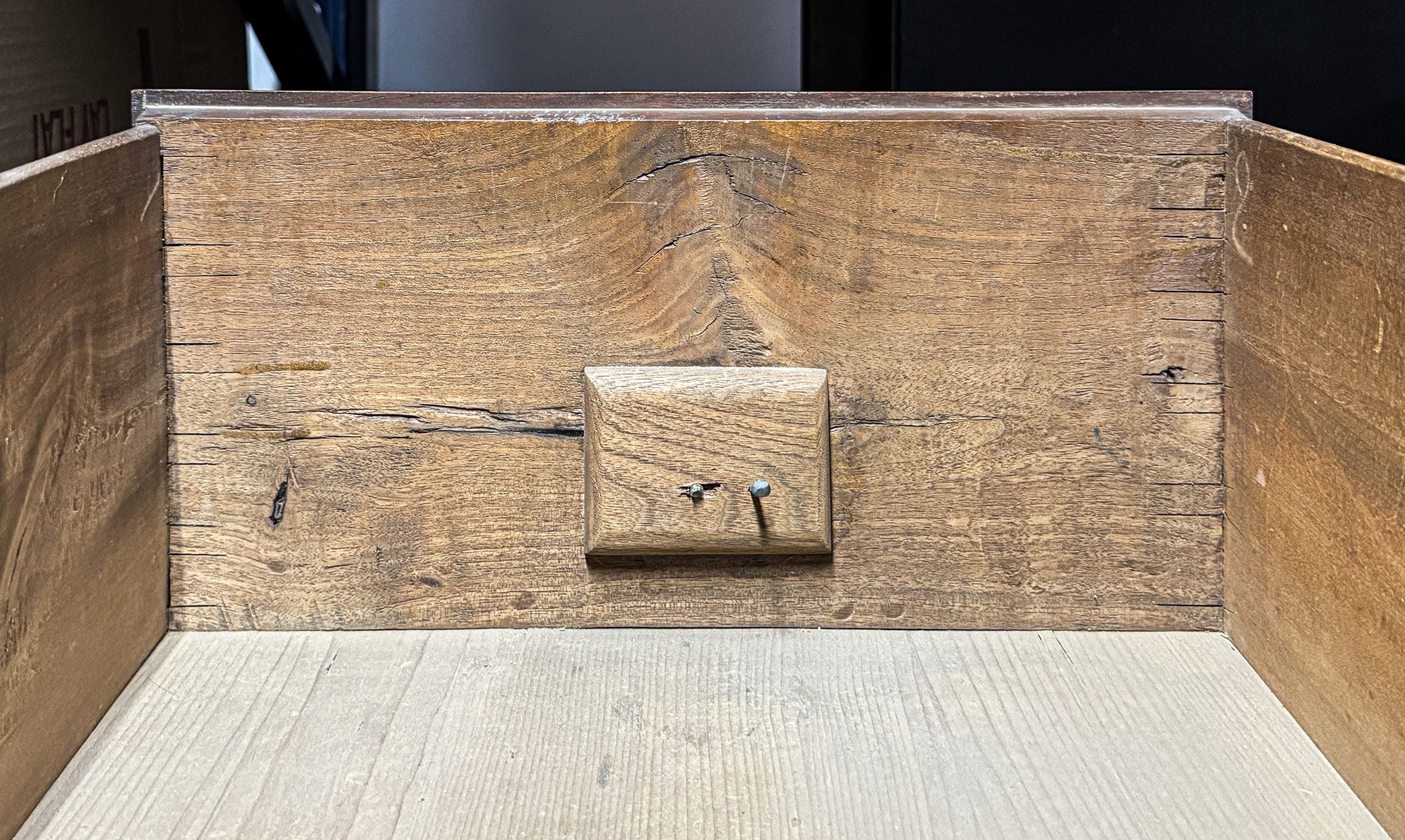
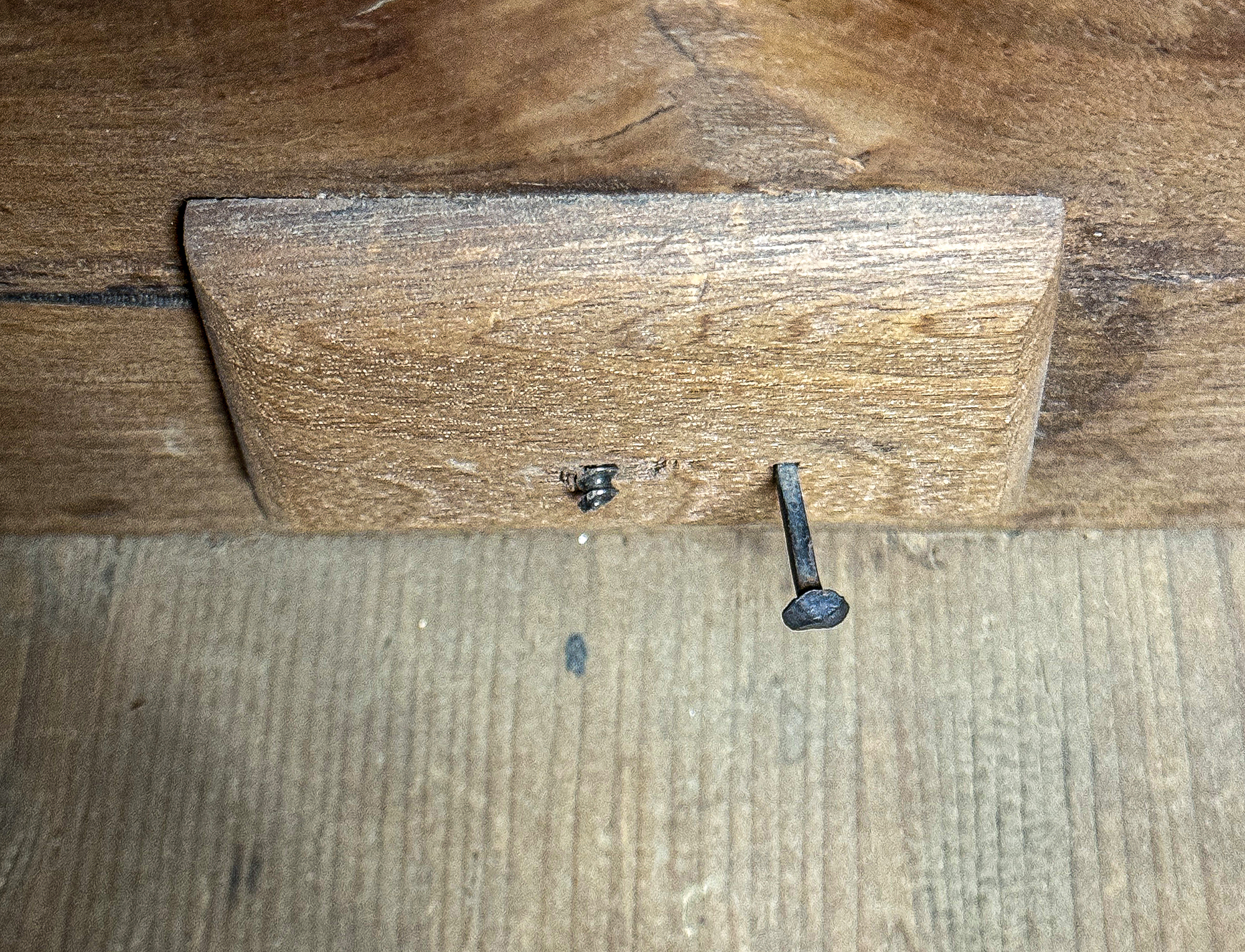
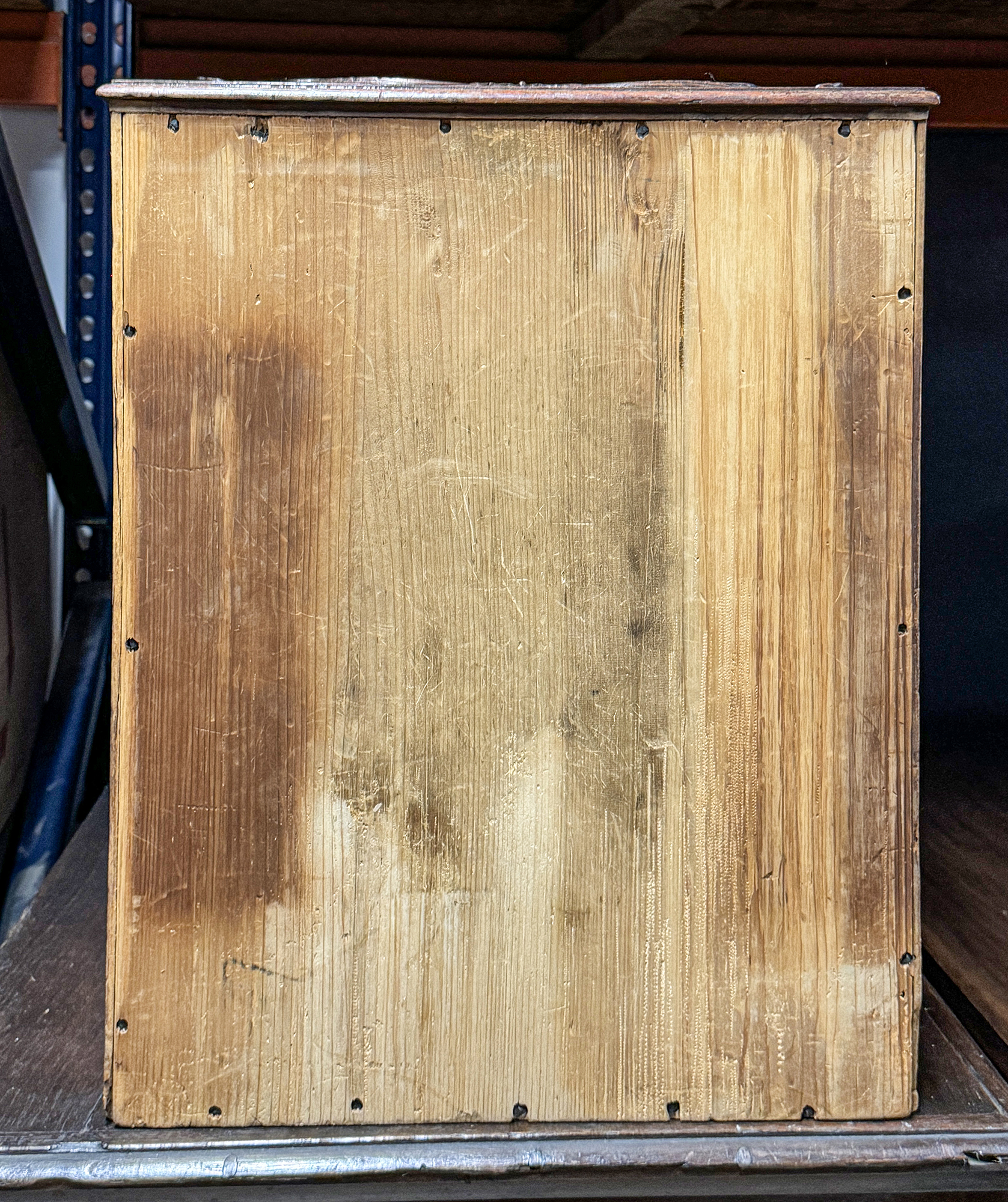
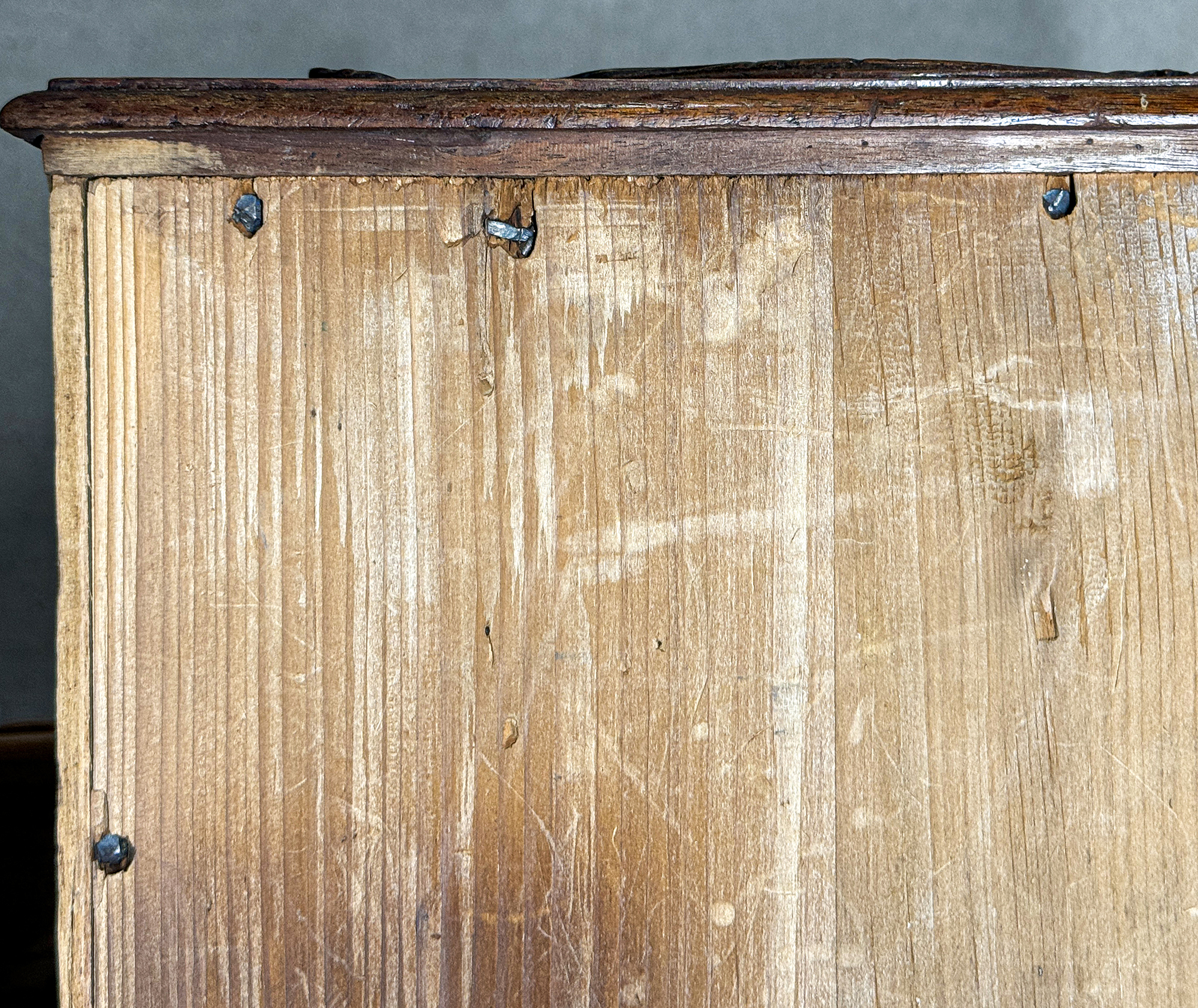
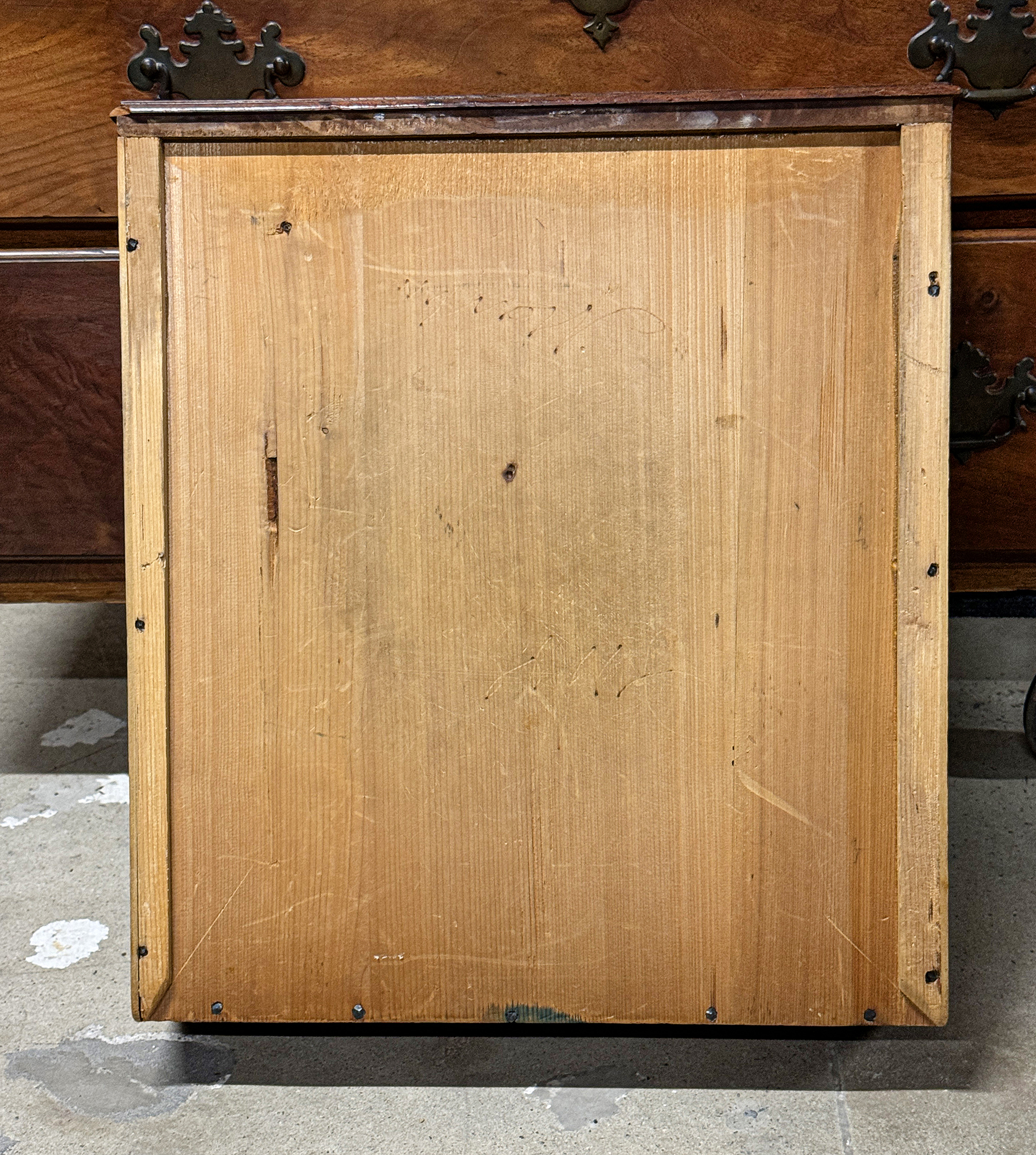
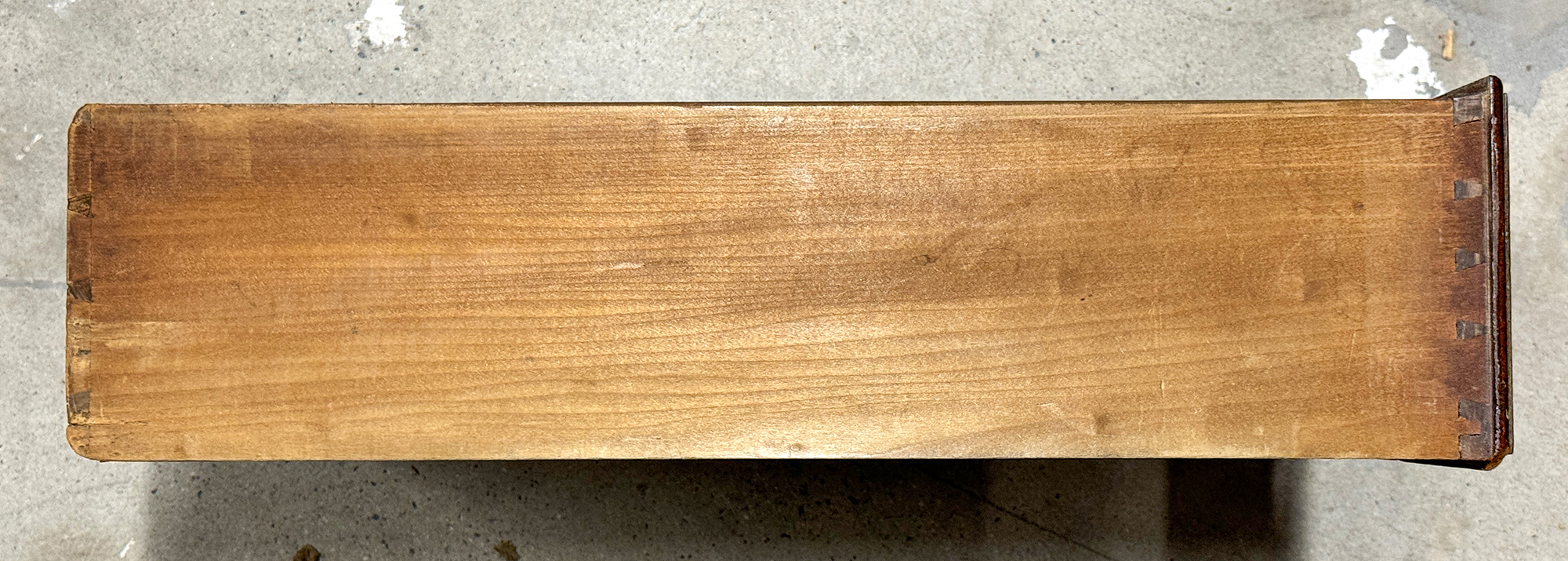
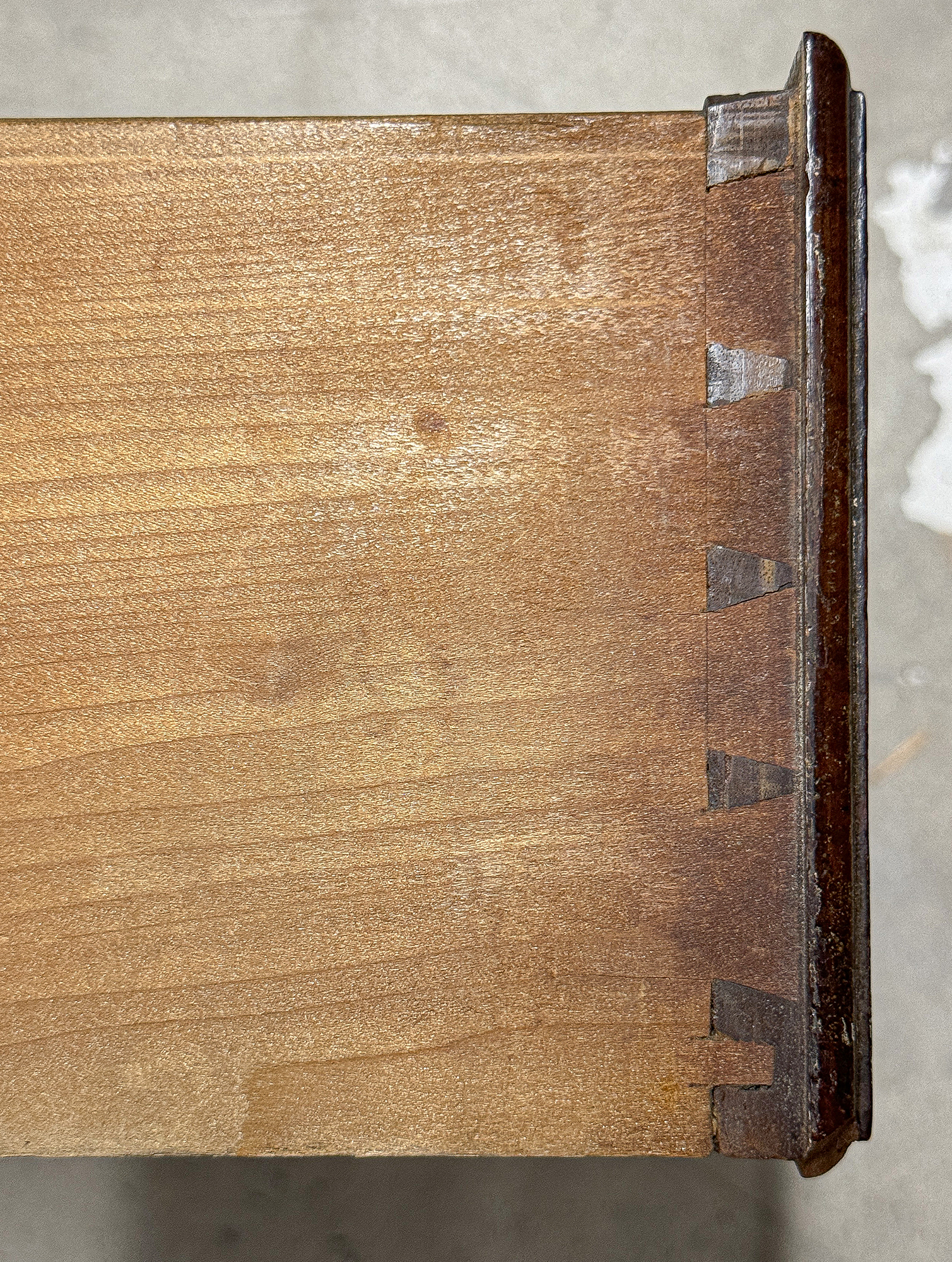
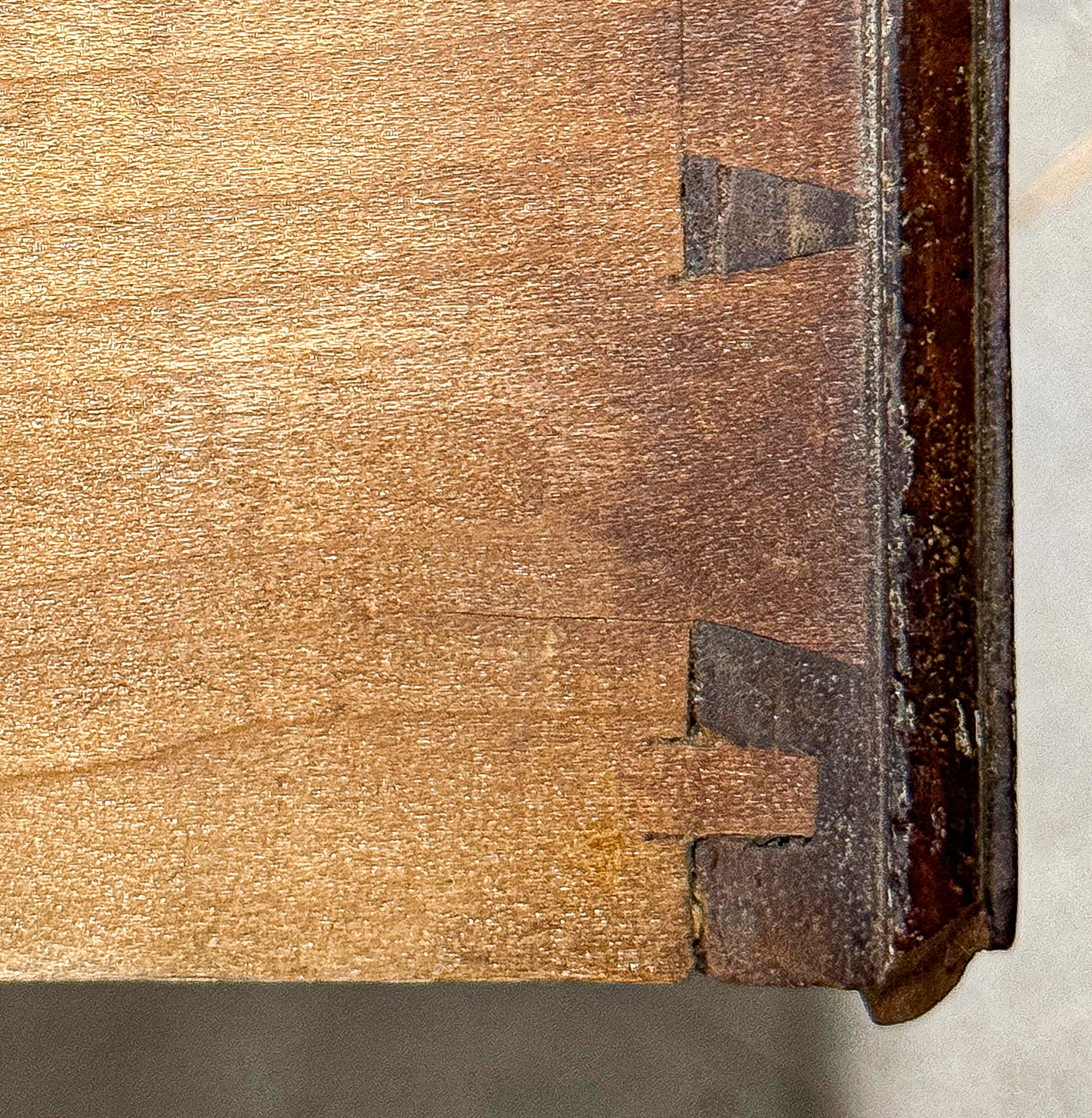
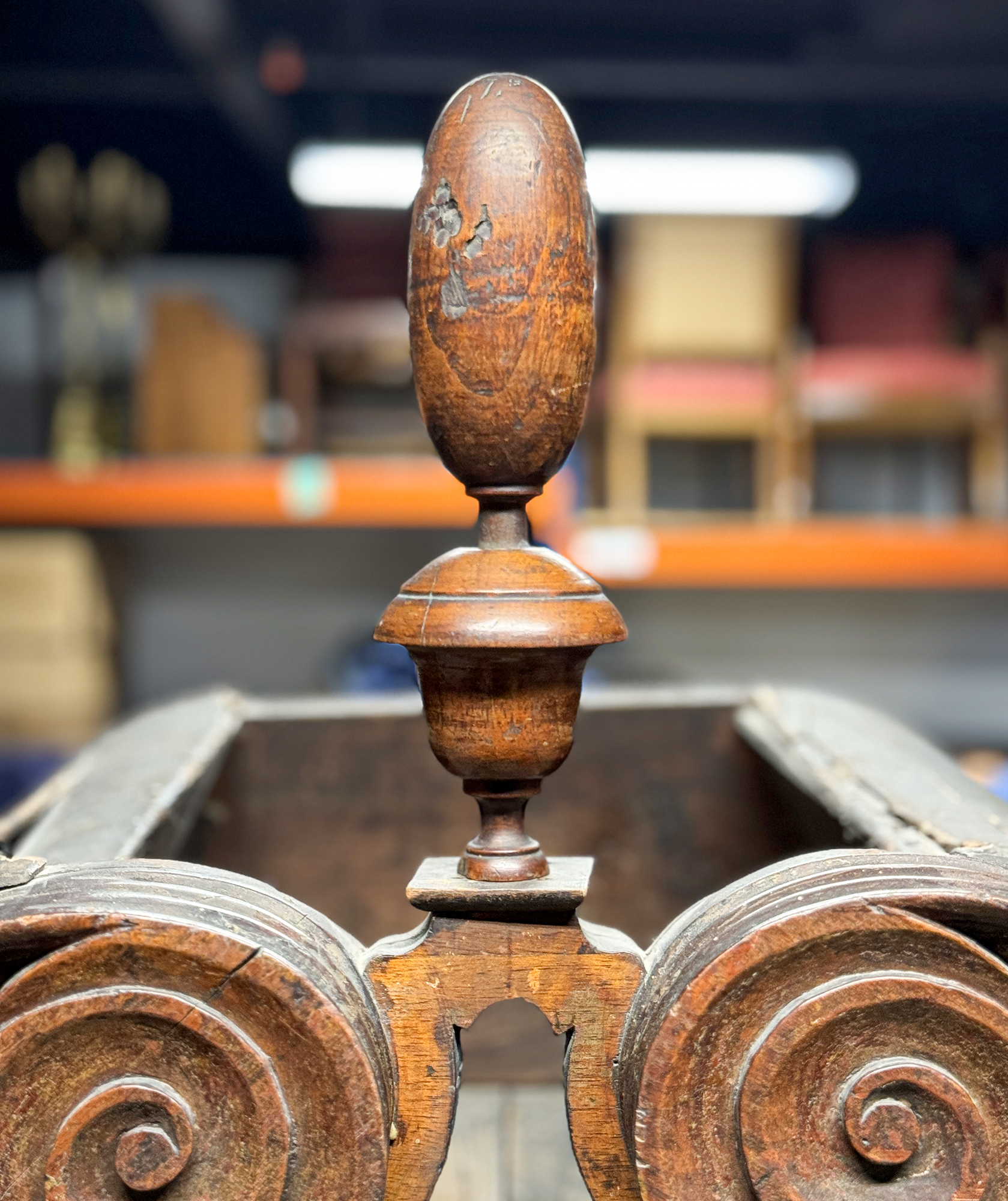
The lower case of the Freeman’s | Hindman chest on chest. Made in Philadelphia c. 1750. Black walnut, yellow poplar, Atlantic white cedar, red gum, brass.The upper case of the chest on chest. The brass is original. The brass handle on the drawer in the top tier was found broken but kept in a small box in a drawer in the lower case.The carved shell drawer and pierced tympanum.Detail of the pierced tympanum.There are two original three-piece finials and with their fluted plinths.A construction detail of the ogee head.The 7/8″ tympanum board was recessed behind the piercings which are about a quarter of an inch thick. This is the area above the shell drawer where the pierced design is missing.More evidence of a pierced design being present at one time above the carved drawer. The recessing stops as the design reaches the arch and spurs at the top of the opening. The arch and spurs were part of the original design and should be incorporated in a restoration of the missing piercing.The recessed tympanum board with original piercings intact.A view from behind the tympanum. The floor of the recessed area was left with a fairly rough surface. Construction of these early scroll top chests are improvisatory. Boards running across the chest at the front and back above the top tier of drawers are dovetailed to the top of the sides and serve structurally as the top board. Both boards appear to be red gum.When carving a drawer with a deep recessed shell, boards 1/4″ to 3/8″ thicker than the boards used for the sides and other drawer fronts are required. However, the board used for the shell drawer front on this chest is the same size as the other drawer fronts and was not thick enough to accommodate the deep relief carving. A small patch of walnut was glued and tacked to the interior surface of the drawer at the deepest part of the carving to give the additional thickness necessary. The additional thickness was also needed to secure the threaded post of the brass drawer pull. You will also be able to observe in the photo of the interior surface of the carved drawer that a slightly figured wood was chosen. This is a very unusual choice for a drawer that is to be carved. Carvers prefer to work with wood that has plain grain. The thickness of the drawer and the presence of a knot with its surrounding figured wood leads me to suspect the drawer front was not intended to be carved when the wood for the drawer was selected.The bottom boards of the three small drawers of the top tier of the upper case and the shell drawer are nailed to rebates in the front and sides and nailed to the back.A detail of a rebated drawer bottom. The carved shell drawer runs on a center drawer support and the top tier drawers are narrow and shallow, the joiner decided these drawers did not need side runners to forestall friction when in use.All the other drawers of the chest, including the two short drawers in the second tier below the shell drawer are supported by runners at the sides. This important development – unseen unless a drawer is removed for examination – in the construction of drawers removed the enormous amount of friction when a fully loaded long drawer had to run on the entire width of its bottom board. In London by the mid 1720s the sides would have a deep rebate that would hide bottom and runner from view producing a cleaner look when the drawer was in use. Joiners in Philadelphia did not generally adapt this form of drawer construction until the early to mid 1740s. The Freeman’s | Hindman chest retains the archaic feature of nailing the runners on with large rose-head nails rather than simply relying on glue. A side view of the drawer. Yellow poplar sides with deep rebates cover the bottom board and runners.Details of a side lap-dovetailed to the front. There are several ways to handle how the bottom is attached to the front. In this instance a groove is plowed in the drawer front to fit the chamfered front edge of the bottom board. The gap left from the groove is filled by a small section of the side. This is a tricky layout with difficulties in creating a tight joint. I’m planning a blog post on the numerous construction variations in Philadelphia furniture that occurred during the transitions from nailed on flush bottom drawers through full rebated bottoms and with runners.
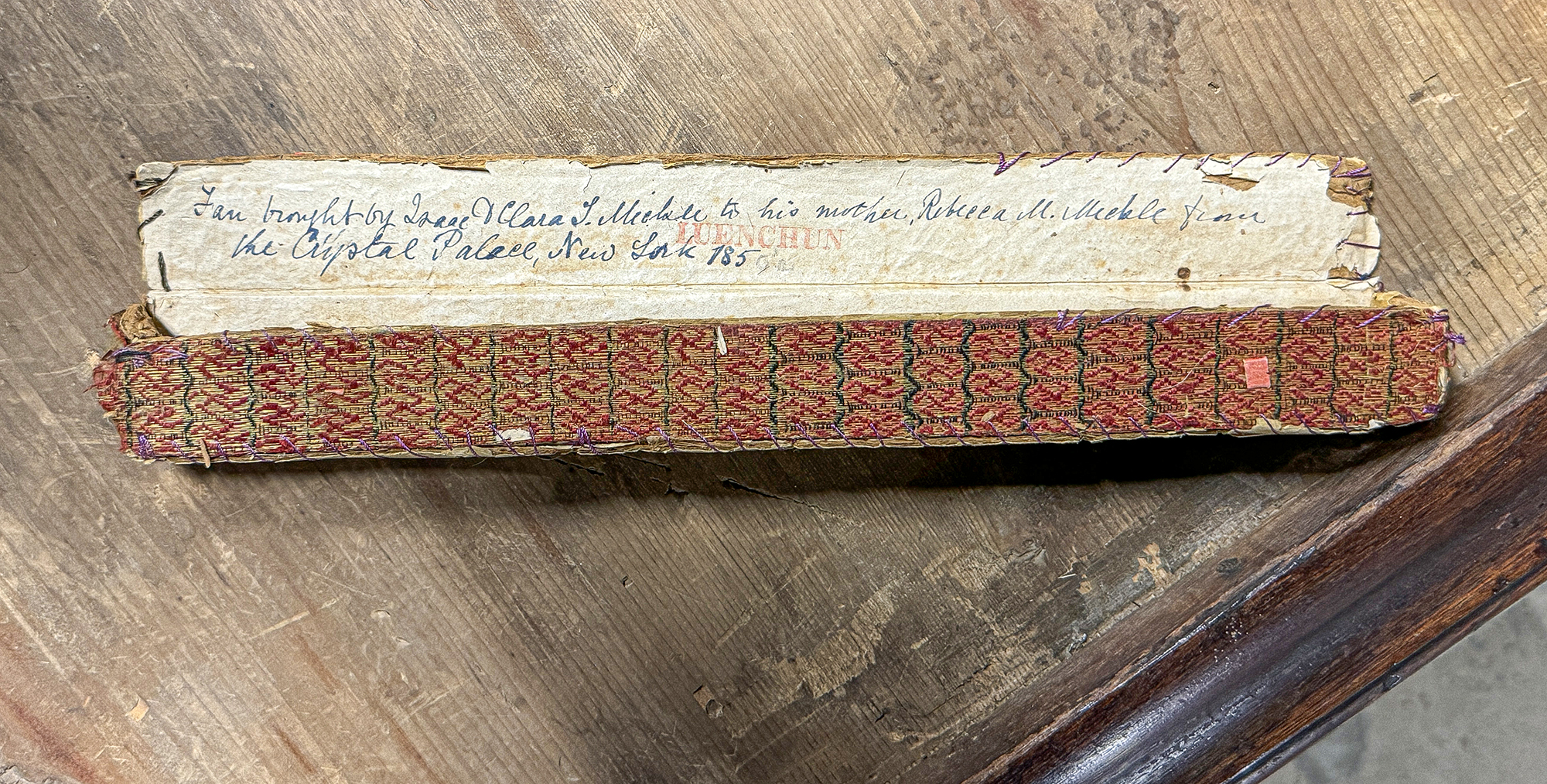
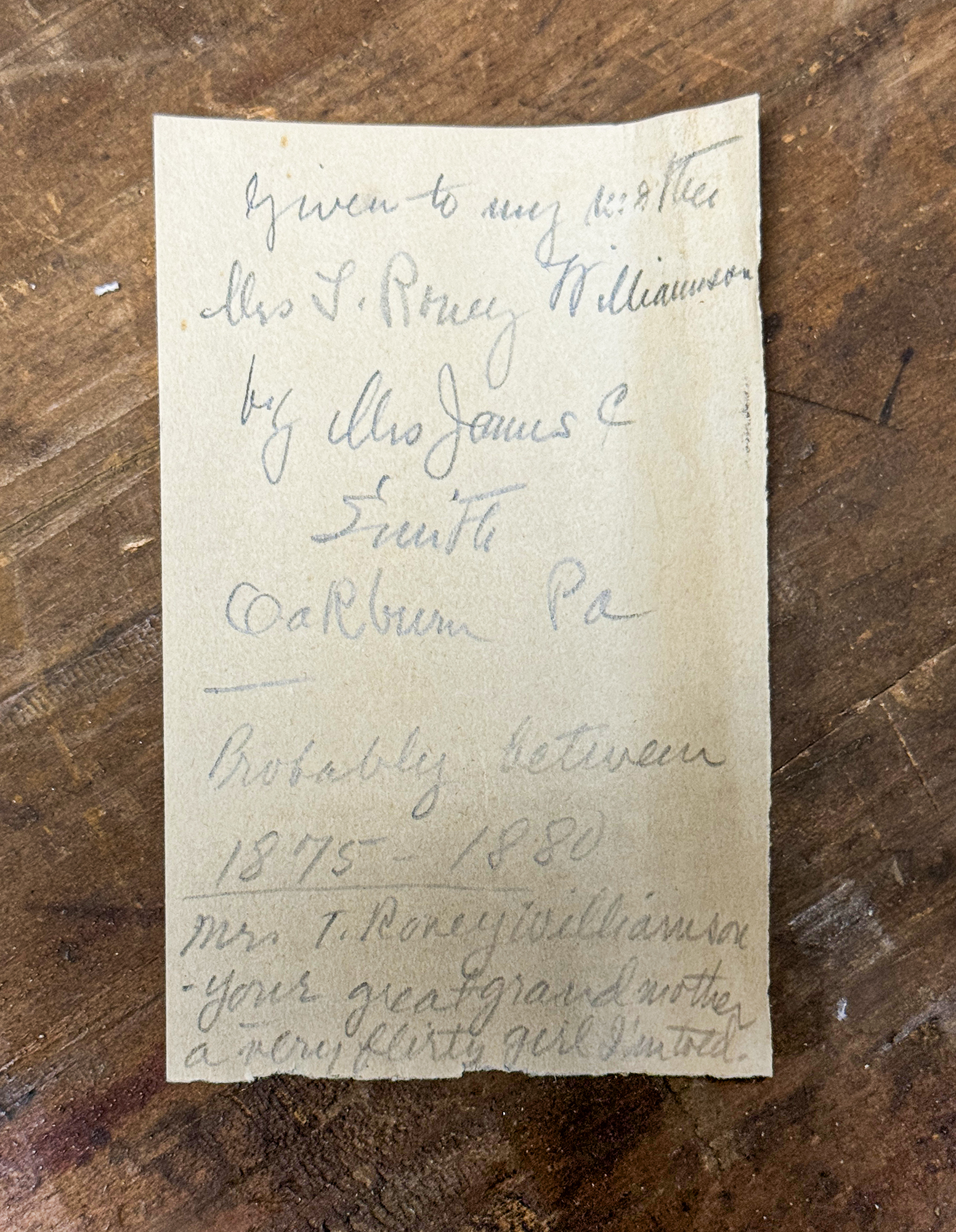
According to the present owner of the chest on chest being sold by Freeman’s | Hindman it has long history of ownership in her Quaker family. It has been in Pasadena, California since the 1930s and recently returned this summer to Philadelphia. Several objects and notes found in the drawer of the chest testify to this. An inscription on a box containing a decorative hand fan describes it as having been purchased by a son and daughter-in-law at the Crystal Palace exhibition in New York in 1853 as a gift for the son’s mother. A note found in the chest may refer to the passing of the chest through multiple-generations.
 In Proportion to the Trouble