I’ve been busy through the spring and summer but I’m looking forward to getting back to more regular posting on the blog and have several topics ready to go. But first this post will both serve as a record of my carving tool collection as it is at this point in time and let you be the first to know of my plans for downsizing the collection in the future.
If you’ve been following this blog since the beginning (September 14, 2010) you may know that it began as a chronicle of a carving project at Mount pleasant, the historic house in East Fairmount Park. Since then, I continued on with the blog focusing on furniture restoration, conservation of historic furniture primarily from the Delaware River Valley and the surrounding area, and investigations into technical aspects of furniture construction. I’ve written several posts that featured a few of my carving tools and the history of their makers but those posts were a small window into the full collection.
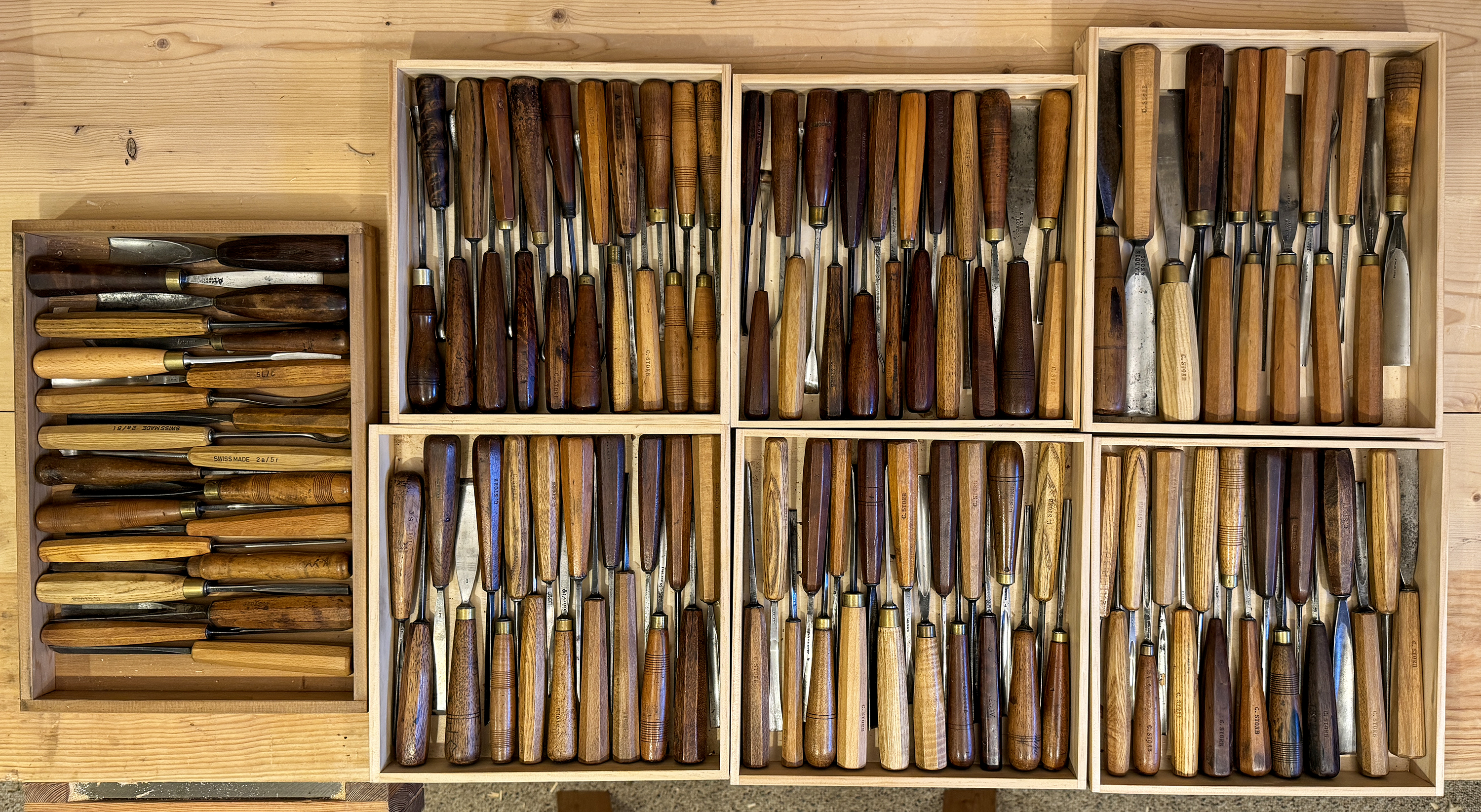
It’s common to over collect something that interests you and that you use almost use everyday in your professional work. That has happened with me over the last 40 years with wood carving tools. Though I have not purchased a carving tool in many years, I find that these days I have many more than I need. I currently own between 180 and 200 carving tools, including many duplicates. I am formulating a plan to keep a core group that could be used for future carving projects while finding a home or a way to offer the others for sale or some type of exchange. From experience I know I could perform any carving that might arise with around 70 or so tools. This leaves about one hundred carving tools of all sorts that would be available.
As I learned more about historic carving tools I became fascinated with the stories of the lives of the makers – the Addis family, the Herring brothers, C. Maiers, and others. I have examined the carving tools owned and used by Daniel Pabst (born Germany 1826-died Philadelphia 1910, all S. J. Addis tools) now in the collection of his great-grandson. and was delighted to learn that J. B. Addis and Sons exhibited their carving tools at the Centennial celebration in 1876 in Philadelphia, winning a medal and adding the date, “76, to their carving tools along with the dates of medals won in England beginning in 1851. Here then is an overview and a little history of my collection.
These are the first carving tools I purchased. Today it’s hard to recall my motivation at the time to buy them from a friend a year ahead of me at college who was graduating from the Furniture-making program at the Philadelphia College of Art. He was serious about continuing his woodcarving work and was saving up to purchase a set of Pfeil carving tools. In 1976, Lou sold these 5 Marples gouges to me for five dollars. It was some time before I knew how to do much with them and I had no idea how to sharpen them when they eventually became too dull to use. But I’ve kept them as a reminder of how early I was curious in the craft. They are not as elegantly wrought as 19th century tools but they still work well now that they are correctly sharpened. My friend Lou would have purchased them in the early 1970s, today they are well over 50 years old. They have had two owners and will have more in the future, woodcarving tools are generational objects. If well cared for, even after as many as three generations of use, they are ready to be passed on to the next generation. The carvers among you may have noticed something odd about this set, I didn’t understand it myself for a number of years – they are different widths, but all are the same #5 sweep, not a set anyone would be advised to start out with today. But as medium sweep gouges – not too slow, not too fast – you can actually do a lot of interesting work with just the five gouges.The 1976 Furniture-making graduating class at the Philadelphia College of Art. Lou is standing forth from the right in a white shirt.
This image shows the bulk of the carving tool collection in shallow stackable trays I made. I have not yet made the box they were intended to be fit to. There are modern Pfeil tools, tools by the brothers S.J. and J.B. Addis, along with some early 19th century tools made by their father, a single not often seen tool marked E. Herring and others by the Herring Brothers, and a small collection of delicate, mostly fishtail shape C. Maiers tools. There are straight and fish-tail gouges, back bent and spoon gouges, double bevel chisels, straight and bent parting tools, and veiners.
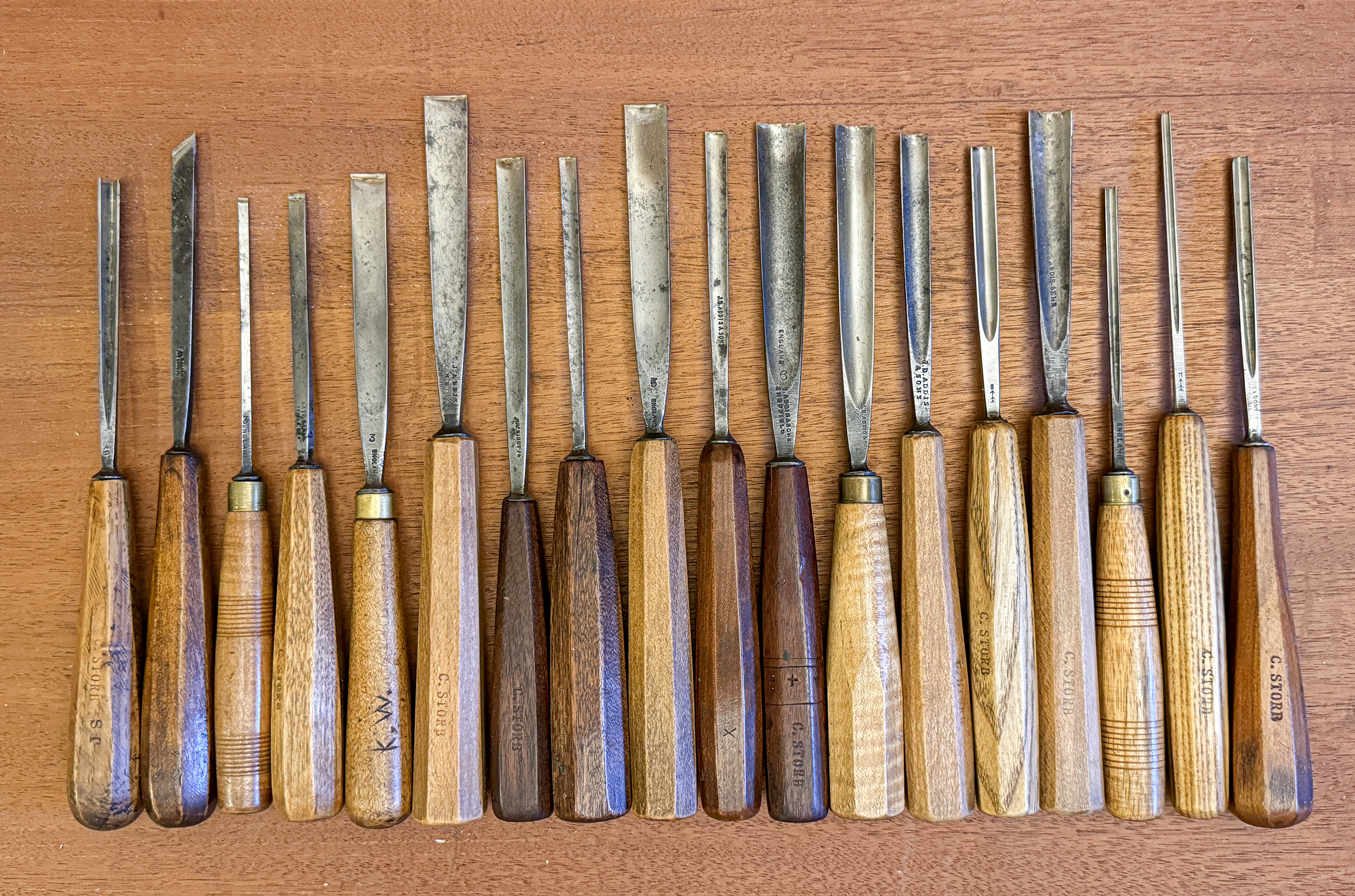
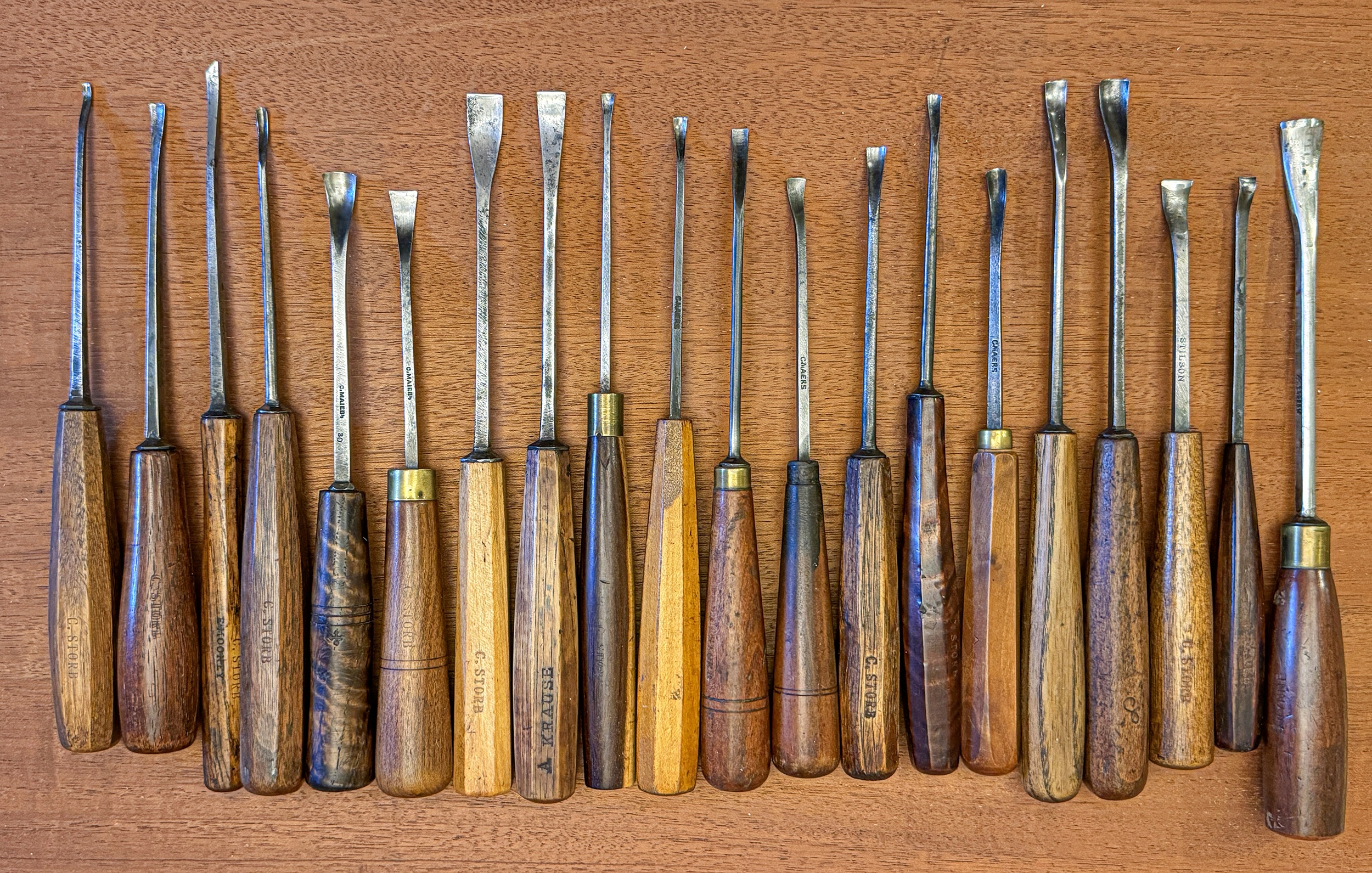
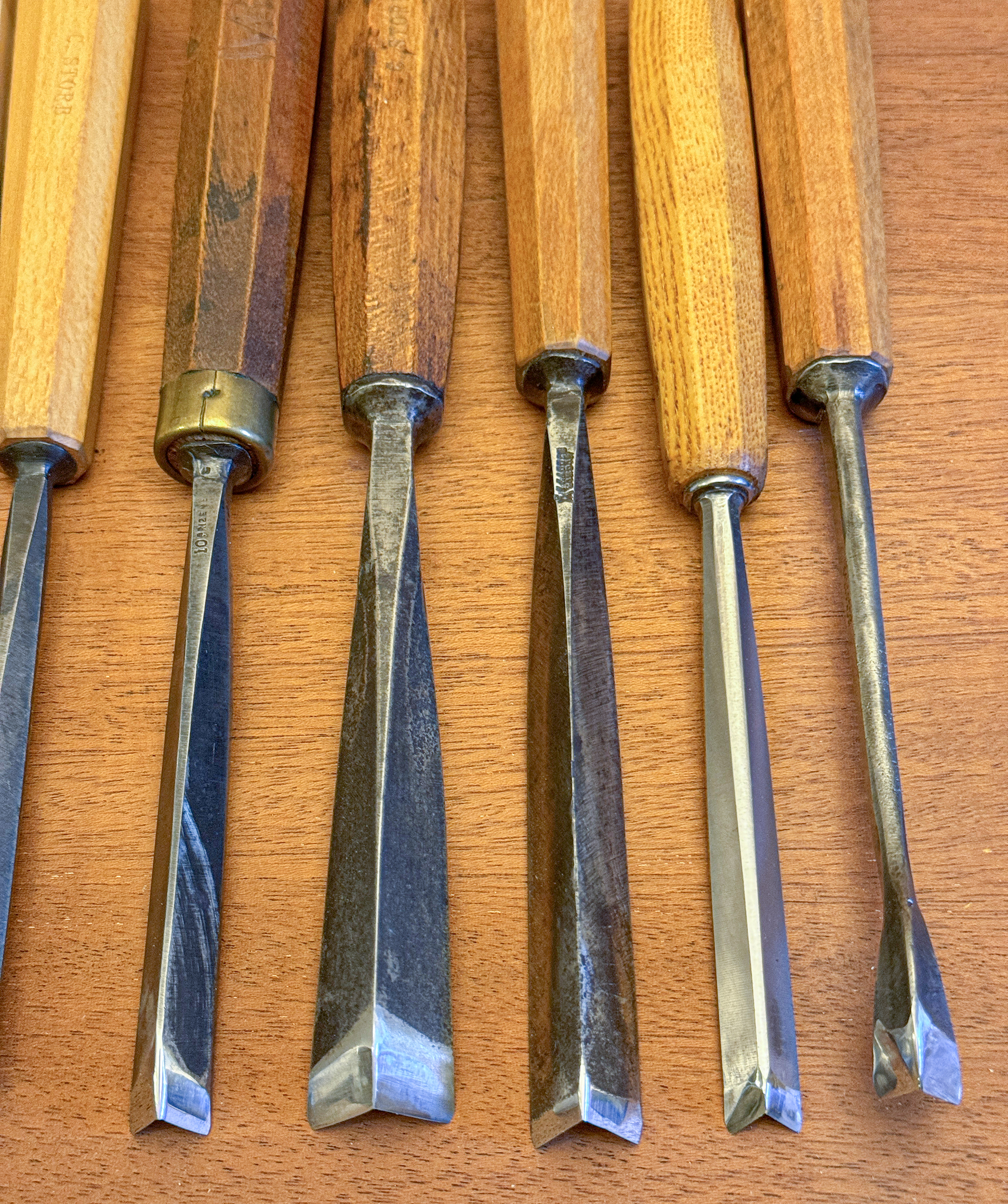
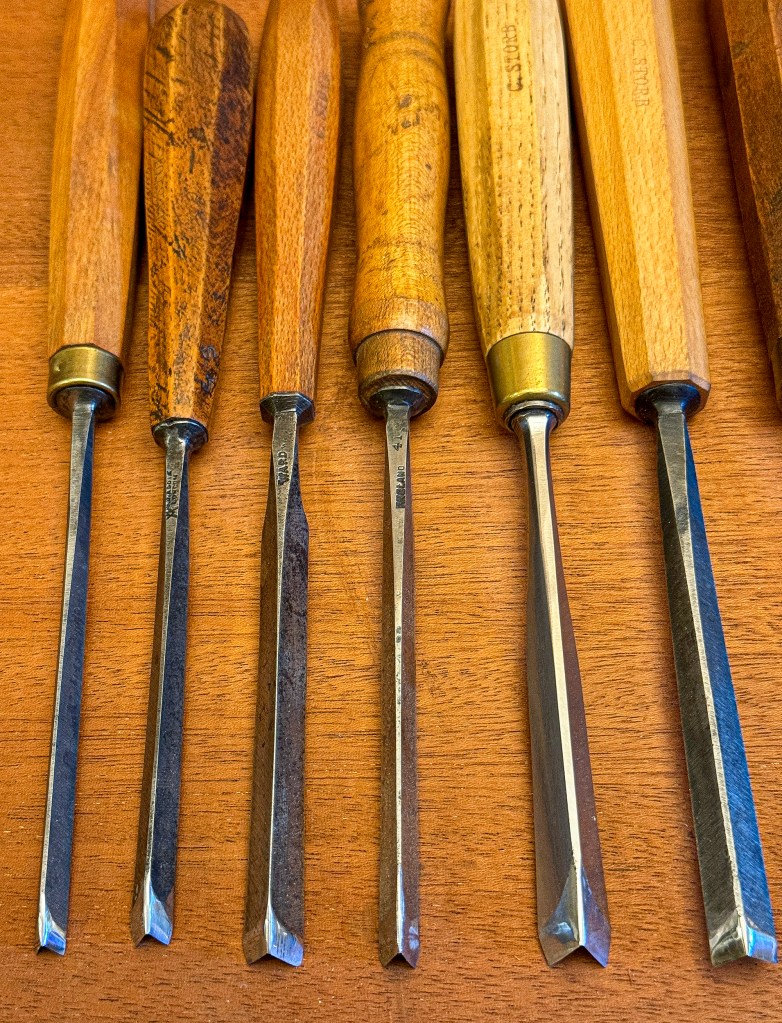
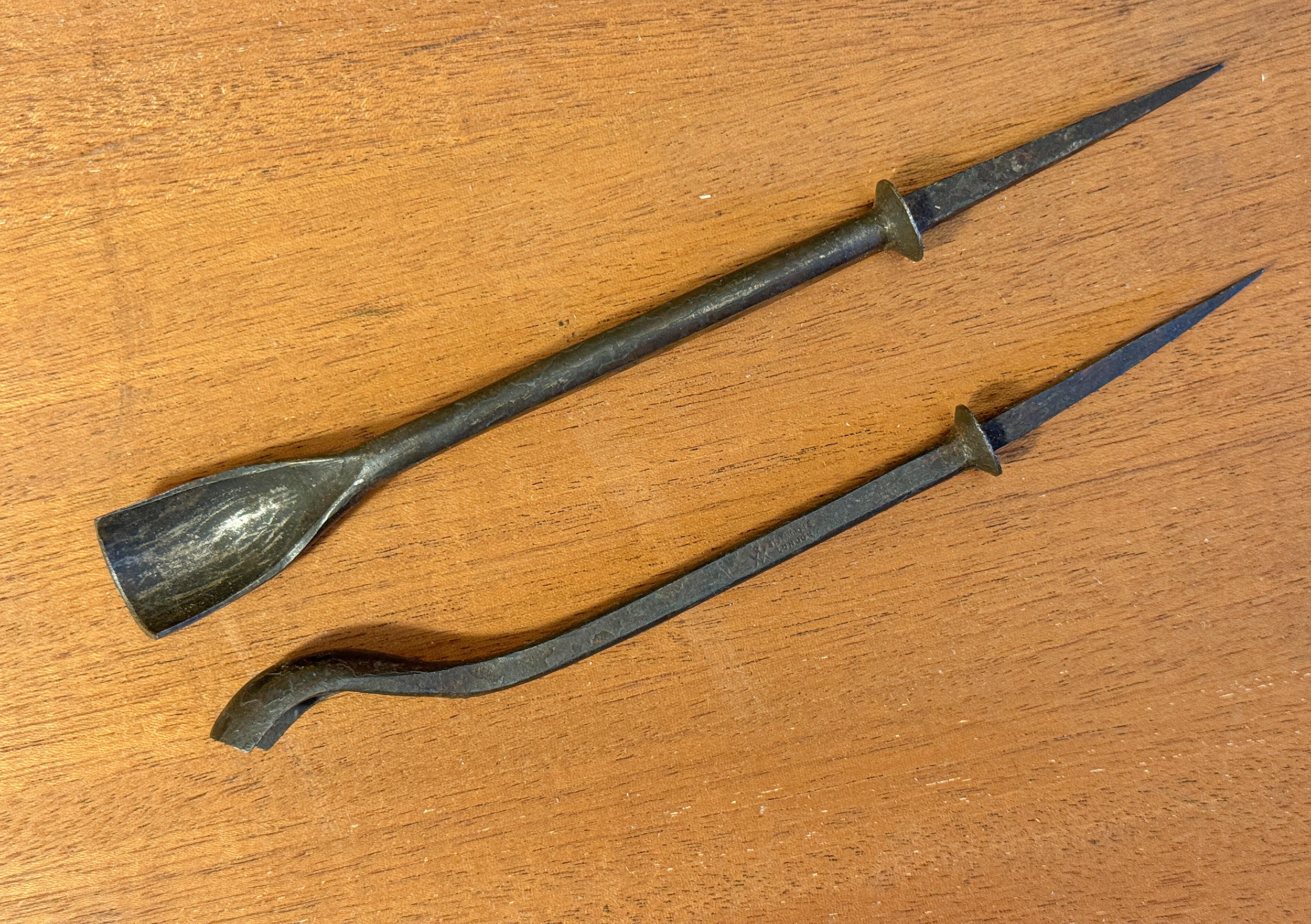
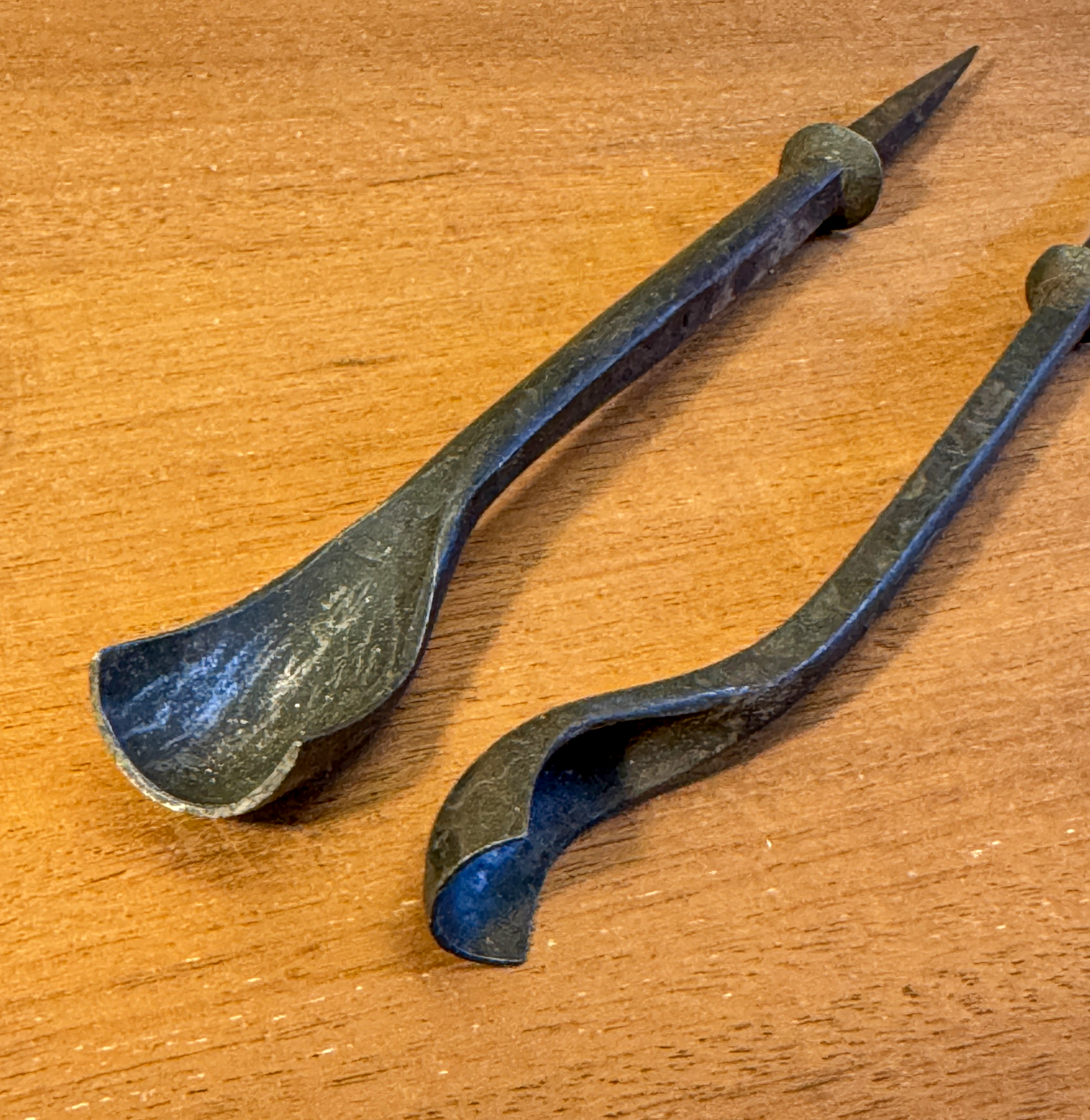
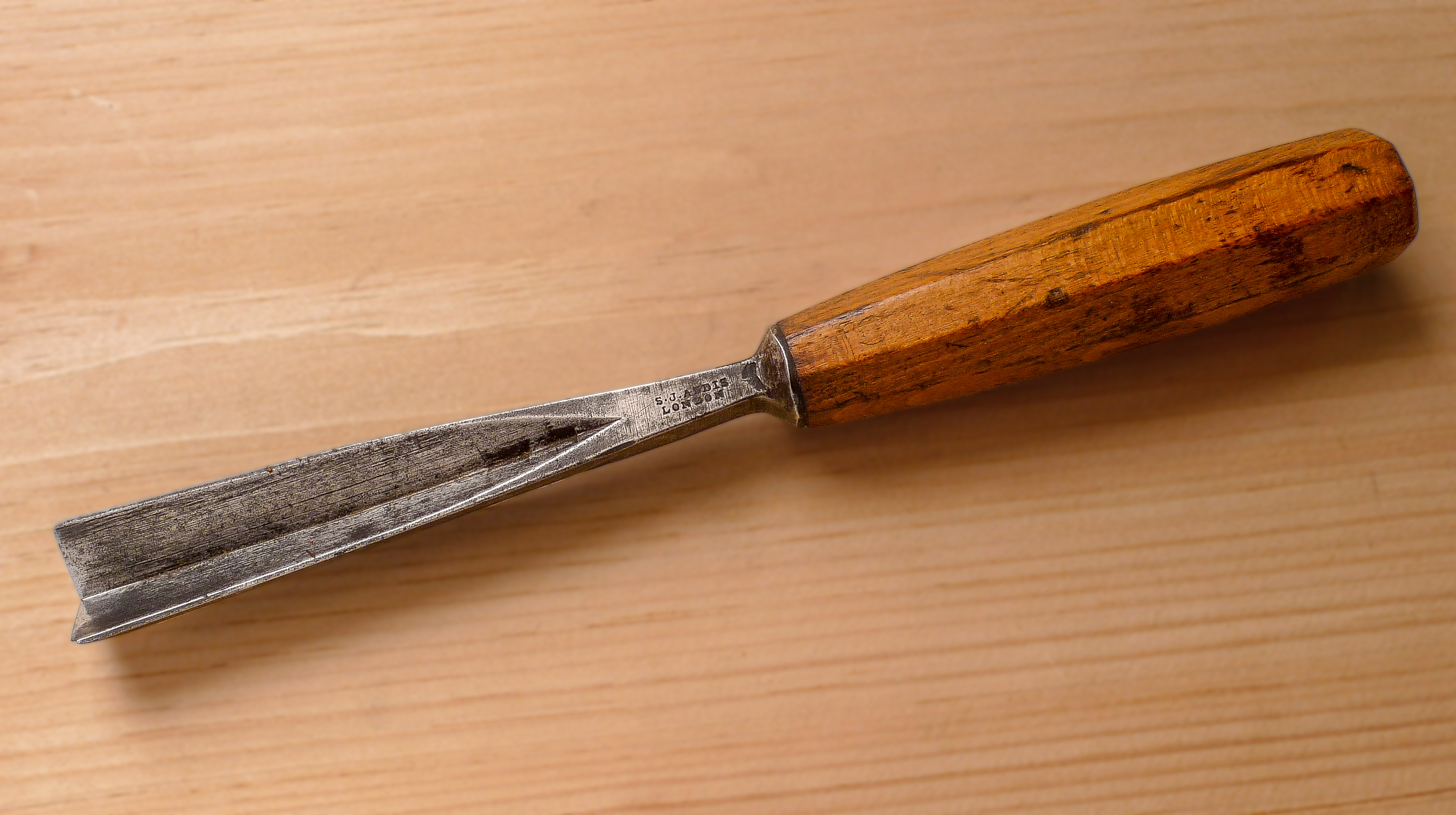
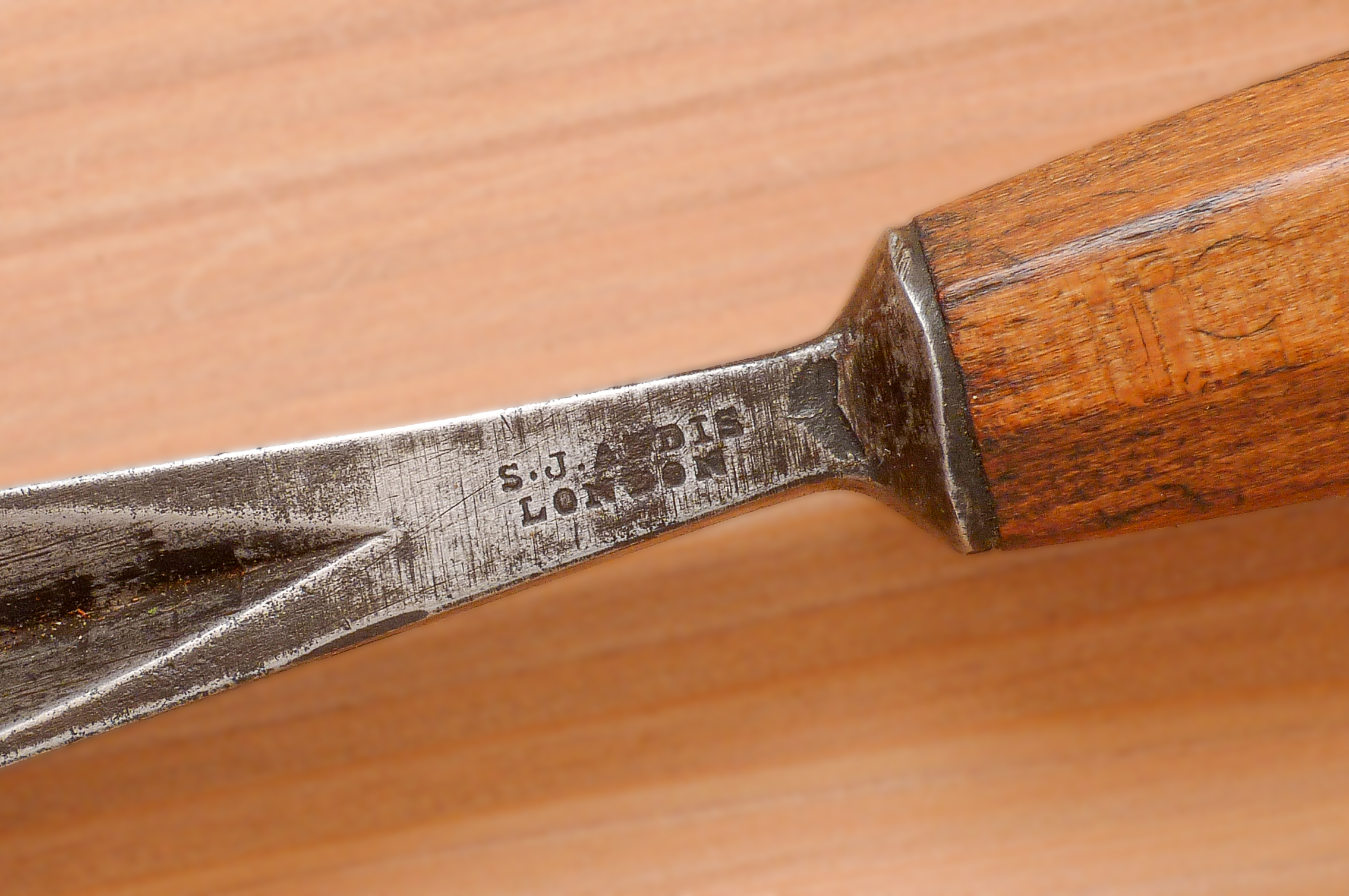
Part of the collection is stored in three cotton carving tool rolls. The five Marples gouges are here along with tools that don’t get used often, duplicates of tools in the trays, and a few that have not yet had their cutting edges shaped and honed.This represents a good basic set of tools to get started with in woodcarving for furniture. From left to right there is a parting tool, a skewed double-bevel chisel, slow sweeps – #3, #4, #5 – in various widths, fast sweeps – #6, #7, #8, #9 – and several veiners of various widths. For deep relief work such as a cartouche ornament, you would need to add a few spoon gouges of various sweeps and widths. Perhaps the earliest gouge that I bought new decades ago is the 3/8 inch #8 sweep gouge, the fifth tool from the right. It’s been used in almost every restoration or reproduction project I’ve been involved with over the years. As you can see by its reduced length, it’s also a tool I learned how to sharpen with.This is the majority of the collection of spoon gouges with three front bent gouges at the right.A collection of parting tools, also know as V-tools. There are different widths and also different angles of the V-shape. Second from the right is the first parting tool I owned, a Pfeil tool I purchased new decades ago. I struggled with this tool until I began to collect historic tools and discovered the difference in how historic tools were forged and shaped which led to understanding how greatly I needed to modify the Pfeil too to have it work for me. About five of the parting tools shown have new handles that I made. If a tool looked interesting and the metal was in good shape, it didn’t matter if it had a badly a damaged handle or no handle at all, making a new one is an easy task and every woodcarver who works with historic tools has made handles at some point. The front bent parting tool on the far right was a great sharpening challenge but owning one can be a lifesaver in certain projects.The back of a few of the parting tools in the previous image. You want the bottom of your cut in the wood made with a parting tool to appear to be a sharp angle. Look at the incredible forging technique of the historic tools third and fourth from the right resulting in a very narrow bottom edge easing the sharpening process and allowing the tool to cut to a full depth. Compare that to the bottom of the Pfeil tool second from the right with its wide, rounded bottom. There was an enormous amount of metal that needed to be removed before the tool could perform as well as the historic tools.More backs of parting tools. All are historic tools except the modern Auriou parting tool second from the right. While a better forging and shaping than the Pfeil, it still needed a fair amount of metal to be removed to work as well as the historic tools.A S. J. Addis Junr (1811-1870) large gouge with a new handle. The sweep is between a #4 and #5. Late 1830s – mid-1850s.S. J. Addis’ younger brother J. B. Addis (1829-1889) also marked the tools made before his father died or retired with JUN. The quality of this narrow, delicate, finely crafted pre-1851 gouge foresees J. B’s prize medal awarded at the 1851 Great Exhibition in the Crystal Palace in London. The lovely mahogany handle, its hard edges softened by years of use, has two owners imprints. If you enlarge the upper image by clicking on it, you will be able to make out the mark G.S.W. On the reverse T. WATSON stamped his name on the handle. It has now been used by at least three generations of carvers. If handled with care, there is no reason to believe it won’t be useful for another one-hundred years.A selection of carving tools from the first decades of the 19th century. A tool marked just “ADDIS” which may be S.J. and J.B’s father Joseph James Addis (1792-1858) or, possibly, his father, Samuel Bayton Addis (1768-1832) though little is known of his work as a tool maker. At the bottom is a tool marked S. ADDIS. I’ve not seen this mark in any other collection. Is this for Samuel Bayton or a little used mark of S.J.?Two front bent gouges marked S.J. ADDIS LONDON with entwined compass and square imprint to the left of his name. They were never polished, retaining evidence of scale produced by the forging process. The accurately forged tangs that fit into the handle are visible. Their sharp edges facilitate the technique of mounting a handle. Before the end of the 19th century, carving tools were not purchased with the cutting edge ground and honed as they come from a manufacturer today. It was up to the carver to grind what ever bevel angle would most suit them.Carving tools appear so simple and in one way they are, a single piece of forged steel and a quickly shaped wood handle. Yet the reason there were only a few English dynastic families making carving tools for over a hundred years is the enormous amount of swages needed to shape scores of different sweeps and sizes of tools. Parting tools could be had from 1/8 inch to 1 inch and every eighth of on inch increment in-between. U-shaped veiners were made from 1/16″ to 1 inch and the same goes for all the sweeps, from slow, nearly flat #3s to half-circle fast sweep #9s. And we haven’t even mentioned spoon, back bent, or long bent tools. The necessary equipment and learning curve was too great to get into the business on a whim, you were born into the trade or apprenticed to one the great carving tool making families.In our use-it-up and throw it away society, it is very rewarding to be in a practice where almost every tool you touch has either been in use for generations or is one that you made and that is just beginning its journey through history.
Excellent information. It’s good to see that your primary bevels are not “textbook” perfect but are good enough to get the carving done. I went out to my shop and looked at my carving tools(125+) and they are very similiar to yours.
The bevels are in good condition. I notice the light bouncing from all over the ceiling and walls distorts their appearance. I’ll have to light an individual tool or two to show their actual appearance.
So very, very interesting. Thank you. And this made me recall all that we guides at PMA learned from you on various days at Mount Pleasant (1763-65) many years ago when it was opened. The highlight I think was the extraordinary carving/restoration you did in the upstairs drawing room frieze. One day when I was there guiding you started telling me about the stairs. I learned about the work that went into making it and the unusual and grand amount of space it takes up, given it is in a country seat. It is a great stairs. Thank you for all you do!
Thank you. About the stairs – interesting that there is only one stair in the main house, no secondary or “servants” stair as all the other large country houses have. This was clearly the original owners intent. Second, although all the other extraordinary woodwork in the house is ascribed to Thomas Nevell’s top journeymen carpenters, there is no accounting for the staircase in Nevell’s account book, not even for the turned balusters. Nevell himself must have been responsible for the bulk of work and added the cost to the final account owed to him by Macpherson.








 In Proportion to the Trouble
Excellent information. It’s good to see that your primary bevels are not “textbook” perfect but are good enough to get the carving done. I went out to my shop and looked at my carving tools(125+) and they are very similiar to yours.
The bevels are in good condition. I notice the light bouncing from all over the ceiling and walls distorts their appearance. I’ll have to light an individual tool or two to show their actual appearance.
Thanks for another useful and inspiring post.
Thank you. Now I’m working on which tools I will retain. You can’t take it with you!
So very, very interesting. Thank you. And this made me recall all that we guides at PMA learned from you on various days at Mount Pleasant (1763-65) many years ago when it was opened. The highlight I think was the extraordinary carving/restoration you did in the upstairs drawing room frieze. One day when I was there guiding you started telling me about the stairs. I learned about the work that went into making it and the unusual and grand amount of space it takes up, given it is in a country seat. It is a great stairs. Thank you for all you do!
Thank you. About the stairs – interesting that there is only one stair in the main house, no secondary or “servants” stair as all the other large country houses have. This was clearly the original owners intent. Second, although all the other extraordinary woodwork in the house is ascribed to Thomas Nevell’s top journeymen carpenters, there is no accounting for the staircase in Nevell’s account book, not even for the turned balusters. Nevell himself must have been responsible for the bulk of work and added the cost to the final account owed to him by Macpherson.
Wow. Thank you.
It’s an old Quaker familySent from my iPad
Fascinating article. Very interesting comments,comparisons concerning shaping of parting tools.
Thanks. It’s something that can better appreciated in person. Maybe a video.